

Anyone who has ever filled out a plat map, drawn a fictional city, or tried to give a new cul-de-sac its own identity knows how quickly the easy ideas run out. Oak, Maple, and Main are taken in every county, and the second page of your brainstorm usually looks a lot like the first. This guide from namesecho.com solves that problem with more than 700 street names across real-world, subdivision, historical, fantasy, and story-ready categories. It also explains the logic behind the best street names, so you can build your own instead of only copying ours.
Good street names do quiet but important work. They help a delivery driver find the right door at night, they tell a visitor something about a neighborhood before they have seen a single house, and in fiction they can set a mood in just two words. A road called Gallows Row and a road called Honeysuckle Lane make completely different promises. Whether you need street names for a housing development, a map for your novel, a tabletop campaign, or a game world, the right choice gives a place instant character.
Before you dive into the lists, it helps to understand how real street names are chosen, what each suffix such as Lane, Court, Avenue, and Boulevard is supposed to mean, and which mistakes cause planning departments to reject proposed street names. Once you know the basics, picking street names becomes much faster and a lot more fun. Scroll on to find unique street names that sound believable, memorable, and easy to spell, then mix and match them to create a name that belongs only to your street, subdivision, or story.
Also Read This: 500+ Funny Goose Names: Silly, Clever and Cute Ideas
Street Names Generator
Free Name Generator
Street Name Generator
Find a memorable street name for a story, fictional town, game, neighborhood, or creative project.
Tip: Generate again to explore more ideas.
How Real Streets Get Named: Rules, Conventions & the USPS
In the United States, street names are not chosen by the postal service. They are approved locally, usually by a planning commission, a county addressing office or a city council, often after a developer submits a plat showing proposed roads. The United States Postal Service does not name anything, but it publishes the standard that everyone else ends up following.
USPS Publication 28 sets out how addresses should be formatted and which official abbreviations go with each street suffix, such as ST for Street, AVE for Avenue, BLVD for Boulevard, CT for Court, CIR for Circle and LN for Lane. Mail sorting machines read addresses in capital letters without punctuation, which is why local offices care about clean, consistent street names.
Emergency services care even more. A 911 dispatcher has to type a name into a mapping system while a caller is panicking, and two roads with similar sounds in the same county can send a crew to the wrong place. That is why so many local rules exist, and why the best street names are distinct on paper and when spoken aloud.
Common Real-World Street Naming Conventions
Rules differ from town to town, but a few conventions show up almost everywhere. Knowing them will save you a rejected application, or at least make your fictional maps feel believable.
- No duplicates within the same jurisdiction. Most counties will not approve a second Willow Street if one already exists in the same postal area. Many also refuse close variants such as Willow Court next to Willow Lane.
- No sound-alikes. Names such as Main and Maine, or Beach and Beech, create confusion for dispatchers and delivery drivers.
- Directional prefixes follow a grid. North, South, East and West prefixes usually relate to a baseline in the middle of town. Inventing them randomly breaks the logic.
- Numbered and lettered grids are common. Manhattan’s grid dates to the Commissioners’ Plan of 1811, with numbered streets running east to west and avenues running north to south. Washington, D.C. uses lettered streets running east to west and numbered streets running north to south, and has no J Street, a gap usually explained by the similarity between the letters I and J.
- Names are limited in length. Many systems cap the characters allowed so that signs, databases and address labels do not overflow.
- Offensive or misleading names are rejected. Reviewers screen out words with vulgar meanings, brand names without permission, and names that imply a road leads somewhere it does not.
- Living people are often excluded. Many jurisdictions require a waiting period or a formal request before a street can carry a living person’s name.
- Themes keep subdivisions tidy. Developers frequently choose a category like birds or trees, which makes a neighborhood easy to navigate and memorable. We cover this later in the subdivision section.
None of these conventions is universal law, so check the rules in the specific place you care about. For everything else, they are a reliable guide to what makes street names feel real.
The Complete Street Suffix Guide (Street vs Avenue vs Boulevard)
The suffix is the part of a road name that does the most work and gets the least thought. It is meant to tell you what kind of road you are on. In practice, cities apply the meanings loosely, but the traditional definitions are worth knowing because they let you assign the right suffix to the right kind of road.
| Suffix | USPS Abbreviation | Traditional Meaning | Typical Use |
|---|---|---|---|
| Street | ST | A public way with buildings on both sides | Standard residential or commercial roads, often east to west in a grid |
| Avenue | AVE | A broad road, often lined with trees or prominent buildings | Major through roads, often north to south in a grid |
| Boulevard | BLVD | A wide road, often with a landscaped median | Main arteries and showpiece routes |
| Road | RD | A general route between two places | Longer routes that link towns or districts |
| Drive | DR | A winding or curving road | Residential loops that follow the terrain |
| Lane | LN | A narrow, quiet road | Low-traffic residential or rural roads |
| Court | CT | A short, usually dead-end road | Small cul-de-sacs |
| Circle | CIR | A road that loops back on itself | Looping residential roads |
| Place | PL | A short or secondary road | Small side roads, often near larger ones |
| Way | WAY | A flexible, generic connector | Short roads that do not fit another label |
| Terrace | TER | A road on a slope or ridge | Hillside neighborhoods |
| Parkway | PKWY | A landscaped road, sometimes with limited access | Scenic routes and wide corridors |
| Trail | TRL | A path-like road, often rural | Country or wooded areas |
The common confusion is street versus avenue. In grid cities such as New York, the distinction is directional: streets run one way, avenues run the other. In suburbs and fictional worlds, an avenue just sounds grander. A boulevard implies width and often a median, and it is a poor label for a narrow lane. If you want your street names to feel authentic, match the suffix to the road’s role. A tiny dead end named Grand Boulevard will read as a joke. We come back to this in the practical guide near the end.
Street Name Generator Formula

You do not need software to produce endless street names. Almost every believable name follows a simple recipe, and once you see it, you can build hundreds of combinations in minutes. Here is the four-step method used by planners, developers and fiction writers alike.
Step 1: Choose a Descriptor
Start with the word that gives the road its character. Descriptors come from a limited number of sources: nature (Cedar, Willow, Falcon), landscape (Ridge, Meadow, Hollow), people (Franklin, Whitaker), trades (Tanner, Cooper), colors (Crimson, Silver), seasons and weather (Autumn, Breeze), or abstract virtues (Liberty, Harmony). Pick the category first, then the word. Choosing a theme keeps you from jumping around and makes the finished set of street names feel designed.
Step 2: Choose a Second Element (Optional but Common)
Many street names are one word plus a suffix, but a second element adds specificity and helps avoid duplicates. Compound names such as Willow Creek, Stone Bridge or Fox Hollow work because they add a place feature. You can also pair two nouns (Hawk Ridge), add a modifier (Old Mill, Upper Meadow) or combine an adjective with a noun (Quiet Pines). The second element is also the easiest way to rescue a name that is already taken.
Step 3: Match the Suffix to the Street’s Actual Function
Now apply what you learned in the suffix guide. A short dead end becomes Fox Hollow Court. A looping road becomes Fox Hollow Circle. A main route through the district becomes Fox Hollow Boulevard. The same descriptor can create several believable street names when the suffix changes and the road’s role genuinely differs. Do not stack incompatible ideas, such as a trail with a median or a lane with six traffic lanes.
Step 4: Check for Duplicates and Confusability
Say the name out loud. Does it sound like an existing road? Does it fit on a sign? Could someone misspell it when typing an address? Search the local address database if the road is real, or your own map notes if the road is fictional. Names that fail this step are rarely rescued by good intentions. If it sounds like another name, change it.
Best Street Names
The following selections work because they are short, memorable and easy to pronounce. They suit both real developments and fictional towns, and they come with a short note explaining why they hold up.
Best Street Name Ideas with Notes
| Name | Why It Works |
|---|---|
| Maple Street | Familiar and warm, instantly suggests a family neighborhood |
| Harbor Lane | Implies water and a working or scenic waterfront |
| Cedar Ridge Drive | Combines a tree with a landform for a hillside feel |
| Willow Bend Road | The word Bend signals a curve, which suits the suffix |
| Liberty Avenue | Patriotic and broad, fits a main through route |
| Stonebridge Court | Two-part name gives a cul-de-sac some personality |
| Orchard Way | Soft, rural and easy to spell |
| Foxglove Place | Distinct and pretty without being hard to say |
| Summit Boulevard | Suggests height and importance, good for a main road |
| Brookside Terrace | The slope-friendly suffix pairs well with a water feature |
| Linden Avenue | Elegant tree name, common in European towns |
| Meadowlark Lane | A bird name that also paints a landscape |
| Copper Creek Road | Color plus water feature, strong sense of place |
| Ironwood Drive | Strong, unusual and easy to remember |
| Sunset Boulevard | Famous for good reason, a rule-follower for wide roads |
| Heritage Way | Works for historic districts and new developments alike |
| Birchwood Circle | A loop with a clean, natural name |
| Garden Street | Plain, readable and friendly |
| Highland Park Drive | Suggests elevation and green space |
| Wren Court | Short bird name for a small dead end |
| Chestnut Street | Classic American tree name |
| Lantern Lane | Cozy and evocative, ideal for a quiet road |
| Bluebell Place | Small and sweet, suits a short side road |
| Granite Street | Strong and no-nonsense |
| Silverleaf Avenue | Slightly elevated tone for a prominent road |
| Mill Race Road | Rooted in history, hints at a lost industry |
| Fairview Terrace | Promises a view, so it should sit on a slope |
| Thistle Way | Distinctive plant name with a pleasing sound |
| Quarry Hill Road | Industrial heritage with a location detail |
| Ember Lane | Warm and unusual, good for fiction and new builds |
The best street names share a quality: you can picture the road without seeing it. They also resist unnecessary decoration. Compare Elm Street with The Majestic Elmwood Grand Promenade, and the first wins every time.
Also Read This: 600+ Fake Country Names for Stories, Games & Worldbuilding
Creative Street Names
When you want a road that stands out without sounding silly, creativity comes from unexpected pairings rather than invented spellings. Avoid replacing letters with symbols or adding extra vowels. Instead, borrow from music, craft, color and abstract ideas. These creative street names work for developments that want a memorable identity.
Creative street names inspired by music and craft: Cadence Lane, Harmony Court, Melody Way, Tempo Drive, Overture Road, Cello Place, Sonnet Street, Ballad Avenue, Lyric Lane, Staccato Circle, Quilt Street, Thimble Court, Loom Lane, Stitch Way, Bobbin Road.
Creative street names built from color and light: Saffron Street, Cobalt Court, Amber Lane, Indigo Way, Vermilion Drive, Ochre Place, Teal Terrace, Pearl Street, Prism Avenue, Lumen Lane, Dusk Road, Dawnlight Circle, Gilded Row, Sepia Street, Moonstone Way.
Creative street names drawn from ideas and virtues: Curiosity Lane, Patience Court, Candor Street, Verity Way, Fortitude Road, Serenity Circle, Tranquil Place, Promise Lane, Wonder Way, Resolve Drive, Insight Avenue, Grace Street, Kindred Court, Unity Lane, Hearth Road.
Creative street names from the workshop and library: Inkwell Lane, Parchment Place, Scribe Street, Folio Way, Quill Court, Compass Road, Sextant Lane, Anvil Avenue, Bellows Way, Lathe Street, Dovetail Drive, Cobbler Court, Plumb Line Road, Chisel Place, Spindle Lane.
The trick with creative street names is restraint. One surprising word per name is plenty. If both halves are unusual, the name starts to read as a brand rather than a road.
Cool Street Names
Cool is subjective, but cool street names tend to be short, a little bit sharp and slightly edgy. They suit modern developments, urban lofts, game maps and fiction with a contemporary feel. Most are single strong nouns with a plain suffix.
Cool street names with a modern, industrial edge: Vector Street, Foundry Lane, Chrome Avenue, Steel Row, Rivet Road, Circuit Way, Neon Street, Turbine Drive, Alloy Court, Axis Boulevard, Signal Street, Relay Road, Dynamo Lane, Pylon Place, Ignition Avenue.
Cool street names with a sleek, minimalist feel: Onyx Street, Slate Lane, Echo Road, Apex Avenue, Zenith Way, Vertex Drive, Nova Street, Orbit Court, Atlas Road, Quartz Lane, Halo Place, Mercury Avenue, Cipher Street, Pinnacle Drive, Monolith Way.
Cool street names with a wild, adventurous tone: Thunder Road, Falcon Drive, Outlaw Lane, Maverick Street, Rogue Avenue, Ranger Way, Canyon Drive, Viper Court, Wolfpack Road, Drifter Lane, Stormline Street, Ridgerunner Way, Badger Run, Coyote Trail, Black Hawk Drive.
Cool street names with a retro flavor: Jukebox Lane, Diner Row, Cinder Street, Roadster Avenue, Vinyl Way, Marquee Street, Pinball Place, Chrome Diner Road, Neon Alley, Starlite Boulevard, Cruiser Lane, Drive-In Way, Soda Fountain Street, Telegraph Road, Matinee Court.
Some of these can sound too themed if you use five in a row, so mix them with plain names to keep a neighborhood believable.
Urban Thoroughfare Identifiers and Metropolitan Roadway Monikers
City cores call for a different register from suburbs. Downtown roads tend to carry names tied to commerce, civic life, transport and landmarks, and they often sound more formal. If you are building a metropolis for a story, a game or a design project, these big-city street names carry that feel without leaning on fantasy.
Downtown and commercial street names: Commerce Street, Exchange Place, Market Square Street, Merchant Row, Treasury Avenue, Bourse Street, Ledger Lane, Franchise Avenue, Mercantile Way, Capital Boulevard, Metro Avenue, Gateway Plaza Road, Union Station Way, Terminal Street, Depot Avenue.
Civic and institutional street names: Courthouse Square, City Hall Avenue, Council Street, Senate Row, Justice Way, Archive Street, Registry Lane, Academy Boulevard, Library Lane, Charter Avenue, Statute Street, Mayor’s Walk, Judiciary Row, Civic Center Drive, Assembly Avenue.
Transit and movement street names: Trolley Street, Tramway Avenue, Subway Court, Viaduct Drive, Overpass Road, Crossing Way, Junction Avenue, Interchange Street, Cable Car Lane, Ferry Landing Road, Rail Yard Row, Switchback Street, Bridgeway Boulevard, Tollgate Road, Pier Avenue.
Skyline and landmark street names: Skyline Drive, Tower Street, Spire Avenue, Penthouse Row, Rooftop Lane, Cityscape Boulevard, Beacon Street, Observatory Road, Monument Avenue, Landmark Way, Plaza Street, Arcade Lane, Atrium Court, Promenade Boulevard, Lakeshore Avenue.
Real cities offer good models for this register. London has Threadneedle Street, Cheapside and Pudding Lane, each carrying centuries of local history. New York’s Wall Street is named after the defensive wall built by the Dutch settlers, and Broadway comes from the Dutch name Breede weg. If your fictional city is old, give its downtown street names an origin story like these, because even a single hint of backstory makes a map feel lived in.
Cute Street Names
Cute street names suit children’s stories, small-town developments, cozy mystery novels and any place that wants to feel gentle and welcoming. They lean on small animals, sweets, flowers, and diminutive words. The key is sincerity, because winking or ironic cuteness is easy to overdo.
Cute street names from the garden and the pantry: Buttercup Lane, Honeybee Way, Marmalade Street, Clover Court, Daisy Chain Road, Peppermint Place, Gumdrop Lane, Cinnamon Street, Berry Patch Way, Sugarplum Court, Biscuit Lane, Thimbleberry Road, Lemon Drop Street, Cobbler Lane, Blossom Place.
Cute street names inspired by small animals: Bunny Hop Lane, Chipmunk Court, Ladybug Lane, Duckling Way, Hedgehog Hollow, Dormouse Drive, Kitten Street, Squirrel Run, Puddle Duck Place, Fawn Lane, Butterfly Circle, Cricket Court, Lamb’s Ear Road, Tadpole Trail, Robin’s Nest Way.
Cute street names that feel like a storybook: Pumpkin Patch Road, Teacup Lane, Button Street, Pocket Park Way, Hideaway Court, Lullaby Lane, Rainbow Row, Tiptoe Street, Cozy Corner Road, Daydream Drive, Nutmeg Way, Pebble Path, Snuggle Place, Giggle Lane, Wishing Well Road.
Cute street names with a seasonal touch: Snowflake Lane, Sunbeam Street, Spring Fling Way, Mittens Court, Puddle Jump Road, Firefly Lane, Maple Syrup Way, Raindrop Place, Hayride Road, Kite Hill Lane, Sprinkle Street, Cocoa Court, Frosty Way, Dandelion Drive, Picnic Place.
If a real developer is considering any of these, remember that cute street names can age awkwardly. Names such as Giggle Lane charm in a picture book but may feel odd on a driver’s license. Reserve the most whimsical ones for fiction and the gentler ones for real addresses.
Also Read This: 750+ City Names: Creative, Fantasy, Historical & Fictional
Nice & Elegant Street Names
Elegant street names do not shout. They imply polish through softer sounds, familiar botanical or classical references, and a certain restraint. They are the street names you see in established neighborhoods with mature trees and well-kept hedges.
Elegant street names with a classical air: Aurelian Avenue, Belmont Drive, Cavendish Court, Devonshire Road, Eden Park Way, Fairmount Boulevard, Grosvenor Place, Hamilton Terrace, Ashcombe Row, Kensington Court, Lexington Avenue, Montrose Lane, Newbury Street, Oxford Circle, Winchester Way.
Elegant street names inspired by gardens and estates: Rosewood Lane, Wisteria Way, Magnolia Court, Camellia Drive, Hawthorne Terrace, Primrose Place, Lavender Row, Gardenia Street, Peony Lane, Jasmine Court, Heather Gate Road, Clematis Way, Ivy Gate Place, Hydrangea Drive, Lilac Terrace.
Elegant street names that suggest quiet luxury: Ascot Lane, Regent Court, Sterling Street, Highgate Avenue, Mayfair Road, Wellesley Drive, Berkeley Place, Whitmore Terrace, Chatsworth Circle, Beaumont Way, Lancaster Court, Pemberton Lane, Cranbrook Drive, Somerset Row, Stratford Place.
Elegant street names with a coastal calm: Seabreeze Terrace, Tidewater Lane, Pearl Harbor Way, Driftwood Court, Lighthouse Lane, Sandpiper Place, Marina Drive, Cove Road, Windward Avenue, Sea Glass Way, Shoreline Circle, Sandbar Court, Mariner’s Row, Saltmarsh Road, Starboard Street.
When choosing elegant street names for a new development, avoid stacking the grandest words together. Wellington Royal Manor Boulevard sounds like a parody. Beaumont Way sounds like a place you would want to live.
Nature-Themed Street Names
Nature is the single most reliable source of street names, and for good reason. Plants, animals and landforms are easy to say, easy to spell and appealing to nearly everyone. They are also the backbone of most American suburbs, which is why a map of almost any county includes a Pine, an Oak and a Cedar. To stand out, move beyond the obvious and combine a species with a landform or a feature.
Tree-based street names: Oak Street, Elm Avenue, Pine Lane, Cedar Court, Birch Road, Maple Drive, Willow Way, Aspen Place, Hickory Lane, Sycamore Street, Poplar Avenue, Walnut Road, Chestnut Court, Spruce Drive, Cypress Circle, Redwood Lane, Beech Street, Alder Way, Juniper Road, Hemlock Court, Dogwood Drive, Magnolia Street, Sequoia Way, Linden Lane, Larch Place.
Water and shoreline street names: Brookside Drive, Riverbend Road, Lakeview Lane, Spring Creek Court, Waterfall Way, Cascade Street, Pond View Place, Fountain Road, Stillwater Lane, Rapids Drive, Tidepool Court, Bayview Avenue, Riverside Terrace, Dewdrop Way, Millpond Road.
Landform street names: Ridge Road, Summit Drive, Canyon Court, Valley View Lane, Mesa Street, Bluff Terrace, Prairie Way, Hollow Road, Hilltop Lane, Knoll Court, Glen Drive, Dune Street, Plateau Place, Foothill Boulevard, Vista Way.
Wildlife street names: Deer Run, Bear Creek Road, Fox Den Lane, Heron Court, Otter Way, Elk Ridge Drive, Owl Hollow, Falcon Crest Road, Raccoon Run, Badger Lane, Moose Trail, Eagle’s Nest Drive, Lynx Place, Beaver Dam Road, Antelope Way.
Wildflower and meadow street names: Poppy Lane, Bluebonnet Trail, Goldenrod Way, Sunflower Street, Wild Rose Road, Columbine Court, Clover Hill Drive, Aster Place, Marigold Lane, Lupine Way, Foxtail Road, Milkweed Court, Chicory Lane, Tansy Trail, Yarrow Way.
A useful habit with nature street names is to pick the species that actually exist in the region you are working in. Palm Avenue in a northern mountain town is a small lie that locals notice, and an authentic species list does a lot to ground a place, real or invented.
Historical & Founder-Inspired Street Names
A great many of the world’s streets carry the names of people. Early settlers, landowners, local politicians, soldiers, scientists and writers all show up on signs. In older American towns, you often find a founder’s surname on the main road, and the names of presidents on parallel roads. The practice is so common that Washington, Jefferson, Madison, Lincoln and Jackson are among the most familiar street names in the country.
If you are naming a road after a historical figure, the usual rule is to use the surname alone, avoid contested figures where a community may object, and confirm the spelling with a primary source. For fiction, create invented founders so that you can give them a story without misrepresenting a real person.
Founder and settler street names: Founders Way, Pioneer Road, Settlers Lane, Homestead Drive, Charter Oak Court, Surveyor Street, Trailblazer Avenue, Proprietors Row, Colonist Lane, Covenant Road, Frontier Way, Wagon Wheel Lane, Cornerstone Drive, Landing Place, First Settler Road.
Surname-style historical street names: Whitaker Street, Hargrove Avenue, Pemberton Road, Ashworth Lane, Calloway Drive, Fairchild Court, Thornton Way, Kingsley Place, Barlow Street, Dunmore Road, Holloway Lane, Prescott Avenue, Sutton Drive, Whitcombe Row, Ellsworth Court.
Street names that preserve local history: Mill Street, Foundry Road, Canal Street, Tannery Lane, Depot Street, Ferry Road, Smithy Lane, Quarry Road, Old Post Road, Toll House Lane, Brickyard Road, Stagecoach Drive, Railway Street, Granary Row, Lamplighter Lane.
Commemorative and civic-virtue street names: Veterans Way, Memorial Drive, Armistice Avenue, Centennial Boulevard, Bicentennial Court, Heritage Row, Legacy Lane, Tribute Street, Remembrance Road, Patriot Place, Constitution Avenue, Independence Drive, Union Street, Victory Lane, Monument Street.
Historical street names also show how a place thinks of itself. Paris names many streets after dates, such as the Rue du Quatre-Septembre, a habit that turns the map into a timeline. The Via Appia in Rome takes its name from Appius Claudius Caecus, who began the road in 312 BC. A street name can be a very small history lesson, and your own street names can be too.
Subdivision & HOA Themed Street Name Systems
Developers and homeowners associations love themes. A set of coordinated street names turns a loose collection of roads into a recognizable neighborhood, and it makes addresses easier to remember. The tactic works because residents and visitors can guess the category and often the next name. Four systems are especially popular, and each one below is a complete set you can adopt or adapt.
The rule with any themed system is variety within consistency. Use the same category, but vary the suffix and the length of the name so the street names do not blur together.
Bird-Themed Subdivision System
Birds give you musical names and plenty of variety, from tiny songbirds to dramatic raptors. Pair larger birds with larger roads and smaller birds with courts and circles.
Bird-themed street names: Cardinal Drive, Bluebird Lane, Sparrow Court, Robin Road, Finch Circle, Wren Way, Oriole Avenue, Thrush Place, Meadowlark Lane, Kingfisher Drive, Heron Road, Egret Court, Osprey Boulevard, Falcon Ridge Road, Hawk Hollow Lane, Nightingale Way, Swallow Court, Goldfinch Drive, Chickadee Circle, Tanager Terrace.
Tree-Themed Subdivision System
Trees are the classic choice and also the most overused. To avoid generic results, favor less common species such as Hornbeam, Sourwood or Tulip Poplar, and combine them with a landscape cue.
Tree-themed street names: Hornbeam Lane, Sourwood Drive, Tulip Poplar Court, Sassafras Road, Buckeye Circle, Persimmon Way, Basswood Avenue, Ironwood Place, Hackberry Lane, Mulberry Court, Catalpa Drive, Tamarack Road, Locust Grove Lane, Pecan Hollow Way, Cottonwood Circle, Silver Maple Drive, Red Oak Terrace, Bald Cypress Court, Black Walnut Road, White Pine Lane.
Gemstone-Themed Subdivision System
Gem names give a development a sparkling, upscale identity and offer plenty of distinct sounds. Because they are easily confused with color words, check that they do not collide with other roads nearby.
Gemstone-themed street names: Garnet Drive, Amethyst Lane, Opal Court, Topaz Road, Sapphire Avenue, Emerald Way, Ruby Circle, Peridot Place, Citrine Street, Onyx Terrace, Jade Lane, Beryl Drive, Moonstone Court, Aquamarine Way, Turquoise Road, Zircon Circle, Agate Lane, Jasper Drive, Obsidian Way, Pearl Place.
Weather & Sky-Themed Subdivision System
Weather and sky names create an airy, open feeling and work well in places with big horizons. They also give you plenty of single words that are easy to read on a sign.
Weather and sky street names: Cloudcrest Drive, Zephyr Lane, Rainbow Court, Sunrise Avenue, Starlight Road, Breezeway Circle, Thunderhead Place, Skyview Drive, Aurora Way, Horizon Lane, Daybreak Court, Twilight Terrace, Equinox Road, Solstice Circle, Meteor Lane, Comet Court, Mist Hollow Way, Cirrus Drive, Gale Point Road, Moonrise Avenue.
If you are advising a real HOA, remember that themes should cover the entire phase of a development, not just the first few roads. Running out of bird names halfway through a build is a surprisingly common problem, and it leads to awkward exceptions. Draft the full set of street names before the first plat is filed.
Also Read This: 700+ Best Knight Names: Medieval, Fantasy & Epic Name Ideas
Trade & Guild District Street Names
Before surnames and numbers became popular, European towns often named streets after the trades practiced on them. Tanners, bakers, smiths and weavers gathered together, partly because of shared needs such as water or fire safety, and the street name stuck. London still preserves several such names. Bread Street, Milk Street, Poultry and Cheapside (from the Old English word for market) each point to what was sold there.
That makes trade-based street names one of the best tools for fictional towns. They suggest a working economy and a believable history in a single phrase. They also work for modern developments that want an artisan or heritage feel.
Food and market trade street names: Baker Street, Butcher’s Row, Fishmonger Lane, Grocers Alley, Brewer’s Way, Vintner Street, Miller’s Road, Spice Merchant Lane, Cheesemonger Court, Greengrocer Row, Dairy Lane, Cooper’s Road, Pie Maker’s Way, Salter Street, Honey Merchant Alley.
Craft and metalwork trade street names: Smith Street, Tinker’s Lane, Goldsmith Row, Silversmith Way, Blacksmith Road, Wheelwright Lane, Cutler Street, Farrier’s Court, Locksmith Alley, Pewter Lane, Armourer’s Row, Saddler Street, Fletcher’s Way, Coppersmith Road, Nailer’s Lane.
Cloth and leather trade street names: Weaver Street, Tanner Lane, Draper’s Row, Dyer’s Way, Tailor Street, Cobbler’s Lane, Glover Court, Spinner’s Road, Fuller’s Alley, Hatter’s Row, Mercer Street, Skinner Lane, Clothier Way, Felter’s Court, Ropemaker Road.
Builder and civic trade street names: Mason Street, Carpenter’s Way, Joiner Lane, Thatcher Road, Glazier’s Row, Plasterer Court, Slater Street, Shipwright Lane, Chandler’s Way, Cartwright Road, Bargeman’s Alley, Lamplighter Lane, Chimney Sweep Court, Cooper’s Hill Road, Stonecutter’s Way.
Good trade street names do not need all the trades to appear. Three or four are usually enough to give a district its flavor, with a few unrelated names mixed in to look organic.
Royal & Noble District Street Names
Streets that carry the vocabulary of monarchy and nobility give a neighborhood a sense of rank. They work for upscale developments in real life and for capital cities, castle towns and court quarters in fiction. The most convincing examples use proper noble titles and heraldic terms rather than random grand words.
Royal and court street names: Crown Street, Sceptre Lane, Throne Road, Regent’s Way, Monarch Avenue, Coronation Court, Royal Oak Drive, Palace Row, Sovereign Street, Kingsway, Queensgate, Majesty Lane, Pageant Road, Coronet Court, Imperial Avenue.
Noble rank street names: Duke Street, Baron’s Lane, Earl’s Court Road, Viscount Way, Marquis Avenue, Countess Lane, Lordship Road, Knight’s Row, Squire’s Court, Baronet Place, Chancellor Way, Steward’s Lane, Herald Street, Seneschal Road, Castellan Court.
Heraldic and ceremonial street names: Banner Row, Standard Lane, Escutcheon Way, Gauntlet Road, Crest Hill Drive, Signet Court, Lion Rampant Lane, Griffin Gate, Pennant Street, Heraldry Row, Coat of Arms Way, Tourney Lane, Jousting Green Road, Charger Court, Livery Lane.
Estate and manor street names: Manor Drive, Estate Road, Parkland Avenue, Hall Garden Lane, Gatehouse Court, Lodge Road, Grange Way, Demesne Lane, Deer Park Drive, Orangery Place, Keep Road, Moat Lane, Drawbridge Way, Turret Court, Rampart Row.
A useful tip for authors: noble names tend to cluster around the center of power. If your palace sits on a hill, let the street names reflect rank as you move away from it. The closest roads feel ceremonial, the next ring feels administrative, and the outer rings feel ordinary and trade-based.
High-District Boulevard Designations and Regal Avenue Call Signs
Beyond the royal core, the most prestigious streets in a city are usually its boulevards and grand avenues. They are wide, often tree-lined, and named to match their status. These designations suit capital cities, financial districts, diplomatic quarters and showpiece routes in both real planning and fiction.
Grand boulevard street names: Sovereign Boulevard, Imperial Parkway, Regency Boulevard, Majestic Avenue, Triumph Boulevard, Grand Concourse Drive, Victory Parkway, Eminence Avenue, Laurel Boulevard, Dynasty Drive, Meridian Boulevard, Prestige Parkway, Coronation Boulevard, Emerald Parkway, Sterling Avenue.
Diplomatic and ceremonial avenue street names: Embassy Row, Ambassador Avenue, Consul Street, Envoy Way, Treaty Boulevard, Concord Avenue, Accord Street, Delegate Drive, Protocol Row, Legation Lane, Parliament Boulevard, Chancery Road, Emissary Way, Summit Concourse, Dignitary Drive.
Showpiece promenade street names: Promenade des Fleurs, Grand Mall Avenue, Esplanade Way, Corso Boulevard, Fountain Parkway, Statue Square Road, Obelisk Avenue, Colonnade Drive, Arcade Concourse, Rotunda Row, Allee of Kings, Monument Mall, Gala Boulevard, Procession Way, Pavilion Parkway.
Notice that some of these borrow suffixes from other languages, such as Corso and Allee. This is common in real cities and a useful trick in invented ones, which brings us to the next big category.
Fantasy Street Names
Fantasy worlds need street names that sound as if they grew out of the setting rather than a modern city planner’s desk. The most effective ones mix plain words with a hint of old-fashioned vocabulary. A few principles help. Use suffixes such as Row, Gate, Walk, Wynd, Steps and Reach rather than modern ones like Boulevard. Pair a familiar noun with a mood word. And remember that real medieval towns named streets after what happened there, so your street names should come from the story of the place.
Fantasy street names for market towns: Silverstitch Row, Hearthstone Walk, Whistling Gate, Candlemaker’s Wynd, Ravenhollow Lane, Goldfinch Steps, Barleycorn Row, Thistledown Walk, Mossgate Road, Lanternfall Wynd, Emberlight Row, Cobblewick Lane, Brindle Gate, Stonemarch Walk, Merrow Steps.
Fantasy street names for elven and woodland settlements: Starleaf Way, Moonpetal Walk, Silverbough Lane, Dewfall Glade, Whisperwood Row, Sunsong Path, Evenstar Reach, Willowshade Wynd, Thornwillow Way, Glimmerbark Lane, Aelindor Walk, Lirael Steps, Nightbloom Row, Faelight Path, Ashenleaf Road.
Fantasy street names for dwarven and mountain holds: Deepdelve Road, Ironvein Row, Anvilgate Lane, Forgefire Walk, Stonehelm Way, Gemcutter’s Steps, Hammerfall Road, Orebreaker Lane, Bouldergate Row, Runecarve Walk, Goldseam Way, Granitehall Road, Embercore Lane, Thunderdeep Row, Mithril Wynd.
Fantasy street names for coastal and port cities: Saltgate Row, Tidecaller Walk, Kraken’s Reach, Driftwood Wynd, Pearldiver’s Lane, Siren Steps, Wavebreak Road, Sailmaker’s Row, Brinewater Walk, Anchor Gate, Lighthouse Reach, Mermaid’s Wynd, Ropewalk Lane, Shipwreck Row, Stormwatch Road.
The best fantasy street names also vary in tone. Not every road in a kingdom is poetic. Some should be blunt and ugly, such as Offal Lane or Midden Row, because real towns had roads like that and a map filled only with flowery names looks naive.
Dark & Spooky Street Names
Spooky street names are a staple of horror fiction, haunted-house attractions, tabletop campaigns and seasonal displays. The best ones imply a story without explaining it. A name like Gallows Hill invites questions, while a name like Nightmare Boulevard answers them too bluntly and loses the dread.
Dark and spooky street names with a gothic tone: Gallows Row, Hollow Grave Lane, Raven’s Rest Road, Widow’s Walk, Bleakmoor Way, Ashen Hollow Street, Cinder Crypt Lane, Wraith Road, Thornwood Cemetery Lane, Mourner’s Row, Grimstone Alley, Candlewax Court, Vesper Street, Nightshade Lane, Dolor Way.
Dark and spooky street names suggesting haunting: Phantom Lane, Whispering Pines Road, Specter Street, Banshee Way, Haunt Hill Road, Lantern’s End, Murmur Alley, Shadowgate Row, Echo Hollow Lane, Revenant Road, Poltergeist Place, Spirit Walk, Ghostlight Lane, Lament Court, Séance Street.
Dark and spooky street names rooted in decay: Rotwood Road, Blight Street, Cobweb Court, Mildew Lane, Withering Way, Rust Hollow Road, Deadfall Drive, Barrow Street, Carrion Lane, Cankerroot Road, Ruin Row, Bonepile Lane, Sorrow’s End, Moldering Way, Desolation Drive.
Dark and spooky street names with a ritual feel: Coven Court, Hex Lane, Ritual Road, Bloodmoon Way, Sacrifice Street, Cauldron Row, Pentacle Place, Eclipse Lane, Warlock Road, Incantation Alley, Hollow Oak Circle, Black Candle Lane, Moonless Way, Witching Hour Road, Midnight Mass Street.
One practical note for writers: the scariest street names often sound ordinary. A road called Pleasant Valley Drive that leads to a terrible house does more work than a road called Death Lane that leads to the same place.
Also Read This: 500+ Ninja Names: Cool, Funny, and Traditional Shinobi Names
Magical & Mystical Street Names
Magical street names are lighter than dark ones and more wondrous. They suit fantasy cities, children’s books, wizard academies and any story where the roads themselves are part of the enchantment. They tend to use words about light, stars, spells, crystals and wonder, and the best ones feel inviting rather than ominous.
Magical street names inspired by spells and wonders: Charm Street, Enchanter’s Way, Wandmaker’s Lane, Runestone Road, Spellbinder Row, Alchemist’s Alley, Potion Place, Sorcerer’s Steps, Glamour Lane, Conjurer’s Court, Incense Row, Talisman Road, Amulet Way, Oracle Street, Cantrip Lane.
Magical street names inspired by the sky and cosmos: Starfall Road, Comet Walk, Moonbeam Lane, Constellation Way, Stardust Alley, Astral Row, Celestial Court, Galaxy Gate, Nebula Lane, Sunstone Steps, Eclipse Walk, Aurora Road, Midnight Sun Way, Zodiac Street, Planetarium Lane.
Magical street names inspired by creatures: Phoenix Lane, Dragonscale Road, Griffin’s Rest, Unicorn Court, Pegasus Way, Sphinx Street, Fae Circle, Pixie Hollow Lane, Hippogriff Row, Basilisk Walk, Selkie Steps, Wyvern Road, Sprite Alley, Kelpie Lane, Chimera Court.
Magical street names inspired by elements and crystals: Crystalline Row, Quicksilver Lane, Prismatic Walk, Glimmer Gate, Everflame Road, Windwhisper Way, Tidecrystal Lane, Aether Street, Stormglass Row, Sunflare Court, Moonwater Lane, Evergreen Charm Road, Starstone Way, Luminous Lane, Gleamcrest Road.
Magic works best when it feels consistent. If your magical street names include a Conjurer’s Court, readers will assume a conjurers’ guild lives there. A good map rewards that assumption with at least one scene.
Fake Street Names for Stories & Writing
Fiction writers face a particular problem: they want street names that sound real but do not accidentally point at a real address. Using an actual road with a real house number can create awkward coincidences, and some publishers and screenwriters avoid it for legal reasons. Invented but plausible street names solve the problem.
The easiest approach is to combine an ordinary descriptor with a suffix and then check the result against a map to make sure no real road with that exact name exists in the city you have in mind. For stories set in invented towns, the check is simply that you do not reuse the name for two different roads.
Fake street names for contemporary fiction: Alder Crest Drive, Pinecone Court, Brightwater Avenue, Hollis Street, Marlow Lane, Crestfield Road, Larkspur Way, Westerly Court, Birchmont Drive, Havenwood Lane, Ridgeline Road, Cobb Hill Street, Fenwick Avenue, Marigold Circle, Elmhurst Place.
Fake street names for mystery and thriller settings: Dunmore Alley, Ferris Road, Greywater Lane, Blackwell Street, Harrow Court, Cutter’s Wharf Road, Marrow Lane, Lockhart Drive, Quillon Street, Ravenscroft Avenue, Stillman Road, Thornbury Place, Vance Street, Wexford Alley, Yarrow Lane.
Fake street names for romance and small-town stories: Honeysuckle Lane, Peach Blossom Street, Sweetbriar Road, Cobblestone Way, Bakery Row, Ivy Cottage Lane, Mistletoe Court, Dovecote Drive, Primrose Hill Road, Harvest Moon Lane, Greenhouse Way, Lilac Lane, Sunnybrook Street, Porchlight Road, Postmark Place.
Fake street names for science fiction settings: Parallax Street, Helix Avenue, Quantum Drive, Warpgate Row, Ion Lane, Cryo Court, Stellar Concourse, Hyperline Road, Vector Alley, Terraform Way, Lagrange Avenue, Orbital Row, Biodome Drive, Arcology Lane, Singularity Street.
A final tip on fake street names: do not make them too clever. If a reader notices the pun before the plot, the street name has become a distraction.
D&D & Game World Street Names

Tabletop game masters and video game designers need street names quickly and in quantity, often in the middle of a session. The rules for good gaming street names are simple. They should be easy to say aloud at the table, they should hint at what the party might find there, and they should be flexible enough to attach to a shop, a tavern or an encounter.
D&D tavern district street names: Tankard Row, Flagon Lane, Barrelhead Street, Mugwort Alley, Hearthfire Road, Dice and Dagger Way, Bardsong Lane, Hopsack Row, Rumrunner’s Walk, Meadhall Street, Brawlers’ Alley, Stumble Inn Road, Last Call Lane, Gamblers’ Court, Roadhouse Row.
D&D adventurer and guild street names: Questgiver’s Row, Mercenary Lane, Guildhall Street, Delver’s Way, Questboard Road, Hero’s Walk, Wayfarer Street, Sellsword Alley, Bounty Row, Dungeoneer’s Lane, Scoutmaster Road, Banner Hall Street, Oathkeeper Way, Trailhead Lane, Armory Street.
D&D thieves’ quarter and underworld street names: Cutpurse Alley, Shadowstep Lane, Smuggler’s Row, Fence Street, Lockpick Way, Gutter Road, Blackmarket Walk, Knife’s Edge Alley, Rat Run, Cloak and Coin Lane, Lowtide Row, Sewergate Street, Bandit’s Rest Road, Dagger Alley, Skulker’s Wynd.
D&D temple and holy ward street names: Pilgrim’s Way, Cathedral Walk, Shrine Row, Cleric’s Steps, Sanctum Lane, Reliquary Road, Vestry Street, Hallowed Court, Paladin’s Gate, Chantry Lane, Altar Row, Benediction Way, Monastery Road, Choir Stall Alley, Sacristy Street.
When you build maps for a campaign, label only the roads the party will actually use. Name the others lightly or not at all, then reuse the best street names whenever the story demands a new district. The players rarely notice, and you save your preparation time for the encounters that matter.
Funny & Weird Real Street Names (Verified Examples)
Real maps are full of oddities, and some of the best street names in the world already exist. The examples below are well documented, but local councils sometimes rename roads, so verify any specific name before quoting it in print. We have deliberately kept this section clean and focused on names that are famous for their history or their quirks.
Genuinely Funny Real Street Names by Category
Food-flavored street names in London. Pudding Lane is best known as the street where the Great Fire of London began in 1666, in a bakery. Nearby Bread Street and Milk Street recall medieval markets, and Poultry names the trade carried on there. These street names are funny to modern ears because they read like a grocery list.
Playful or tongue-twisting street names. Whip-Ma-Whop-Ma-Gate in York, England, is often cited as the street with the shortest street and longest name combination in the city. The word gate there comes from the Old Norse for street, which surprises many visitors who expect a doorway.
Street names with a gruesome origin and a cheerful reputation. The Shambles in York is a narrow medieval street lined with leaning timber buildings. The word shambles originally meant a butchers’ market, and the name has long outlasted the trade.
Street names that are famous for being small. Rue du Chat-qui-Pêche in Paris translates roughly as street of the cat who fishes. It is among the narrowest streets in the city, at roughly 1.8 meters wide, which makes the whimsical name oddly fitting.
More Documented Funny Street Names
Not every strange street name is silly. Some are curious because of the system behind them. Washington, D.C. has no J Street, even though it has an I Street and a K Street, a quirk usually blamed on the visual similarity of the two letters. Mincing Lane in London takes its name from the Old English word for nuns, and Threadneedle Street, home of the Bank of England, is a reminder that finance and tailoring once shared the neighborhood. Wall Street still follows the line of a long-vanished defensive wall.
These examples hold a lesson for anyone inventing street names. The funniest and most memorable ones are not random. They have a reason behind them, even when the reason is lost to most people who walk past the sign.
International Street Naming Traditions
Street names look very different around the world, and borrowing from other traditions is a good way to make your own more distinctive. Here is a quick tour of how several countries and languages handle the subject.
France. Streets are called rue, avenue, boulevard, impasse (dead end), allée and place. Many French streets are named for people and dates, so a single Parisian map can read like a history textbook. Names such as Rue de la Paix (Street of Peace) and Boulevard Saint-Germain show both the civic and personal side of French street names.
Italy. Common words include via, viale, corso, vicolo (alley), piazza and largo. The Via Appia, begun in 312 BC, is among the oldest named roads in Europe, and Italian towns often name streets after dates, saints and local patriots.
Germany and German-speaking countries. Straße, Weg, Allee, Gasse and Platz dominate. Berlin’s Unter den Linden means under the linden trees, which is as direct as street names get.
Spain and Latin America. Calle, avenida, paseo, carrera and callejón are everywhere. In Colombia, calles and carreras form a numbered grid, with calles running one direction and carreras the other. Barcelona’s La Rambla takes its name from an Arabic word for a sandy riverbed.
Japan. Most Japanese streets do not have names at all. Addresses are based on districts, numbered blocks and building numbers rather than named roads, so the system works the opposite way from most Western countries. When a street does have a name, it is usually a major avenue or a nickname. This is a fascinating contrast for anyone building a fictional city, because it proves a map can function without conventional street names.
South Asia. Common words include marg, path, gali (lane), chowk (a crossing or square) and sarak or road. Many cities have roads named after leaders, scholars and poets, and some historic roads, such as Mall Road in several cities, keep colonial-era names alongside newer official ones.
Russia and Eastern Europe. Ulitsa, prospekt and ploshchad are standard. St. Petersburg’s Nevsky Prospekt is among the best-known avenues in the region.
The United Kingdom and Ireland. Street, road, lane, close, gate, row, mews and wynd all appear. A mews was originally a row of stables behind a grand house, and a close is usually a dead end. UK street names tend to be older and more irregular than American ones, since many predate formal planning.
If you are inventing a culture for a story, pick one real tradition as a model, keep its suffix vocabulary consistent, and let your street names borrow its rhythm. A consistent set of foreign-sounding suffixes does more for believability than any number of invented words.
Avenue, Court & Circle Names (By Suffix Type)
Different suffixes call for different kinds of names. A grand avenue and a tiny court should not sound alike. These sections give you suffix-specific street names so you can match the name to the shape of the road.
Avenue Names (Prominent, Grid-Adjacent)
Avenues are the showpieces of a street network. They are long, wide and well lit, and they usually connect important destinations. Their names should sound confident.
Avenue street names: Lexington Avenue, Heritage Avenue, Orchard Avenue, Crestview Avenue, Union Avenue, Pioneer Avenue, Sterling Avenue, Garfield Avenue, Beacon Avenue, Franklin Avenue, Laurel Avenue, Ridgeview Avenue, Oakmont Avenue, Pacific Avenue, Meridian Avenue, Colonial Avenue, Brookfield Avenue, Elmwood Avenue, Riverton Avenue, Windsor Avenue, Highland Avenue, Prospect Avenue, Summit Avenue, Vineyard Avenue, Cypress Avenue, Harvest Avenue, Liberty Avenue, Parkside Avenue, Fairmont Avenue, Westbrook Avenue.
Court Names (Small, Dead-End)
A court is the most intimate suffix. It usually serves a handful of homes and ends in a turnaround. Short, soft names work best.
Court street names: Wren Court, Aspen Court, Fox Run Court, Cobblestone Court, Ivy Court, Honeysuckle Court, Brambleberry Court, Quail Court, Tamarack Court, Linden Court, Bluebird Court, Sandpiper Court, Pebble Court, Hazel Court, Teal Court, Mallard Court, Kestrel Court, Rosemary Court, Sparrow Court, Thyme Court, Cricket Court, Dogwood Court, Bellflower Court, Lark Court, Marten Court, Sorrel Court, Primrose Court, Mulberry Court, Starling Court, Hollyhock Court.
Circle Names (Looping Roads)
A circle is the perfect place for names that imply a ring or a return. Words such as Round, Crest, Bend and Loop reinforce the shape, but they are not required.
Circle street names: Cypress Circle, Willow Bend Circle, Heron Circle, Autumn Circle, Greenbriar Circle, Wedgewood Circle, Sunrise Circle, Meadow Loop Circle, Oakleaf Circle, Harvest Moon Circle, Stonegate Circle, Whitetail Circle,
Birchwood Circle, Evergreen Circle, Pinecrest Circle, Foxfire Circle, Orchard Circle, Rolling Hills Circle, Quail Hollow Circle, Maple Crest Circle, Lakeshore Circle, Fieldstone Circle, Crossroads Circle, Dove Circle, Timber Ridge Circle, Heritage Circle, Sandstone Circle, Briarwood Circle, Wild Plum Circle, Cardinal Circle.
Matching name and suffix is a small detail that readers and residents notice without knowing why. A loop called Straight Arrow Circle would feel wrong, while a loop called Roundabout Circle would feel too pointed. Aim for names that feel natural and say nothing about their own geometry.
Rural & Ranch Road Names
Country roads follow different rules. They are long, sparse and often named after the destination, the landowner, the landscape or a long-gone landmark. Rural road names also work hard for practical reasons, since many rural areas use them for emergency addressing, and ranch entrances often carry their own names. These country street names suit farms, ranches, rural subdivisions and western or pastoral fiction.
Farm and ranch road street names: Cattle Drive Road, Hayfield Lane, Windmill Road, Corral Way, Pasture Gate Road, Silo Lane, Haystack Road, Grain Elevator Road, Ranch House Trail, Branding Iron Road, Longhorn Trail, Dry Creek Ranch Road, Bunkhouse Lane, Rail Fence Road, Stockyard Road.
Prairie and plains street names: Tallgrass Trail, Big Sky Road, Wind Prairie Lane, Cottonwood Creek Road, Buffalo Run, Sagebrush Trail, Tumbleweed Lane, Dust Devil Road, Golden Wheat Road, Horizon Line Road, Antelope Flats Road, Bluestem Lane, Prairie Rose Road, Coyote Flats Road, Homestead Section Road.
Orchard, vineyard and woodland street names: Apple Orchard Road, Cider Mill Lane, Peach Grove Road, Grapevine Trail, Vineyard Lane, Pecan Grove Road, Maple Sugar Road, Cherry Hill Lane, Hickory Nut Road, Berry Farm Road, Sawmill Road, Logging Camp Trail, Timberline Road, Fern Hollow Road, Tamarack Bog Road.
Western and mountain-flavored street names: Wagon Wheel Trail, Gold Rush Road, Prospector’s Lane, Silver Mine Road, Switchback Trail, Eagle Pass Road, Lone Pine Trail, Bighorn Road, Rimrock Road, Aspen Grove Lane, Mule Deer Trail, High Meadow Road, Cinder Cone Road, Snowshoe Lane, Stagecoach Pass Road.
In rural settings, directional or destination names are also common. A road called County Line Road or Mill Town Road tells a driver where it goes, which is a practical virtue that fancier street names rarely match.
Also Read This: 700+ Pirate Names: Male, Female, Crew, Ship & Funny Ideas
Countryside Path Tags and Pastoral Highway Naming Blueprints
For stories, game maps and planned communities set in open country, pastoral naming conventions give a place a slower rhythm. The names borrow from footpaths, bridleways and old farm tracks, and they feel more like descriptions than formal designations. Think of them as a blueprint for naming roads that follow the land rather than the grid.
Footpath and bridleway street names: Stile Lane, Hedgerow Walk, Cowslip Path, Bluebell Bridleway, Kissing Gate Lane, Meadow Footpath, Lych Gate Walk, Packhorse Way, Drovers’ Track, Ridgeway Path, Old Coach Road, Greenway Lane, Hawthorn Walk, Nettle Lane, Ploughman’s Path.
Pastoral highway street names: Wheatfield Highway, Shepherd’s Pass Road, Harvest Highway, Pastoral Parkway, Greenfield Turnpike, Cowbell Road, Hillcrest Highway, Old Mill Turnpike, Barnstead Road, Farmstead Parkway, Valley Turnpike, Country Squire Drive, Haymaker Highway, Dovetail Turnpike, Lowland Road.
Hamlet and village-green street names: Village Green Lane, Duck Pond Road, Chapel Lane, Parsonage Lane, Maypole Way, Smithy Green, Almshouse Lane, Churchyard Path, Well Lane, Market Cross Road, Cricket Green Lane, Rectory Road, Pump Lane, Common Road, Church Stile Walk.
Pastoral street names work best when they sound a little worn. Slight irregularity, a hint of age and a connection to a specific feature of the land make the difference between a place that feels planned and a place that feels grown.
How to Name a Street (Practical Guide)
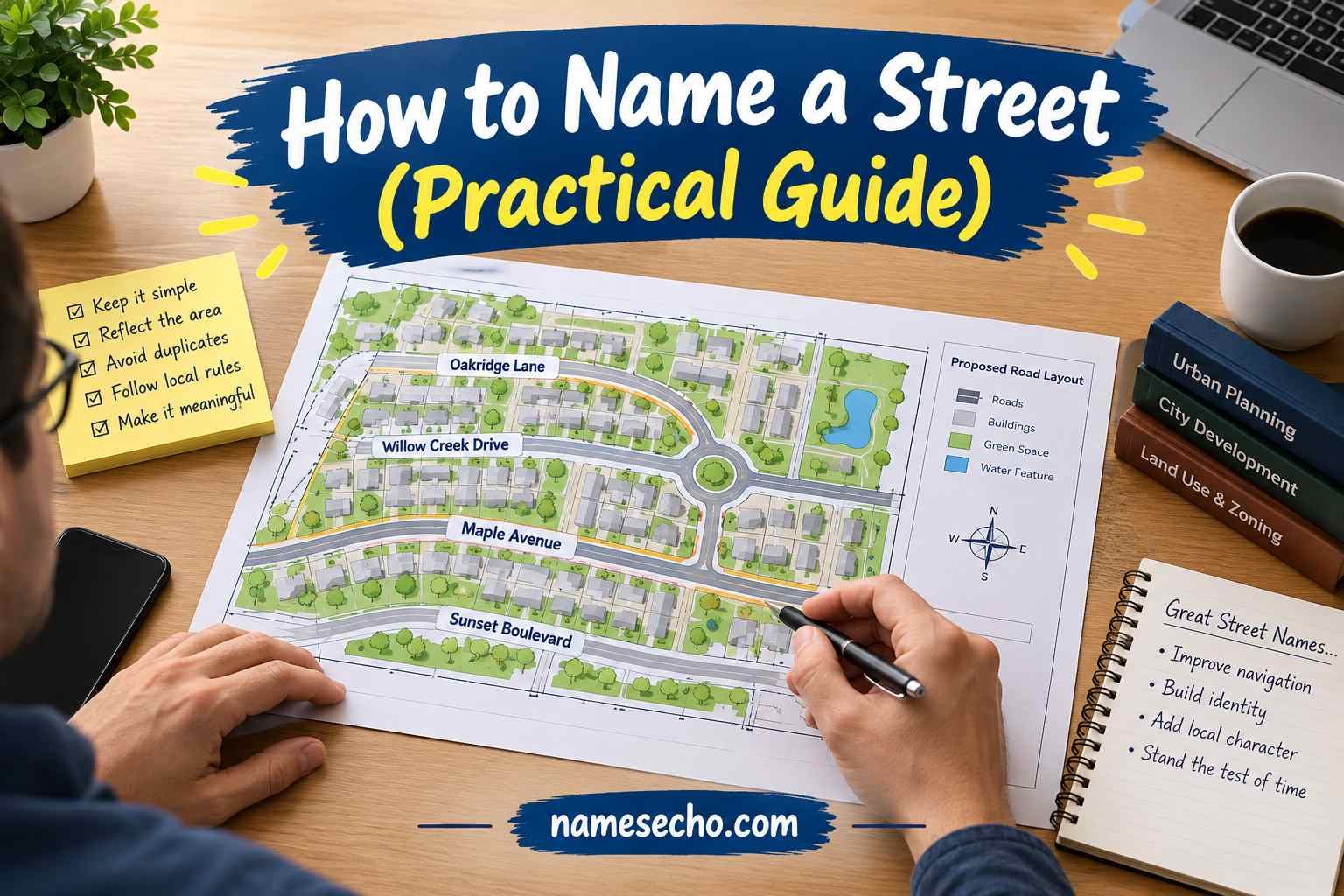
You now have hundreds of options, but the choosing still takes judgment. These four tips cover the practical side, whether you are naming a real road or building a world.
Tip 1: Check Your Local Planning Department First
If your street is real, the planning department, county addressing office or city engineer is where the process begins. They can tell you which names are already taken, what character limits apply, whether themed sets are encouraged, and what the review timeline looks like. Many of them keep a reserved names list or an approved names bank. Asking early can save weeks. A developer who shows up with a finished set of street names that all conflict with existing roads will start over.
Tip 2: Match Suffix to Actual Street Function
We covered the suffix guide earlier, but it is worth repeating here because it is the easiest mistake to avoid. If the road is a through route, it should not be a court. If it is a dead end, it should not be a boulevard. The suffix is a promise to everyone who reads the sign. Keeping it consistent makes your street names feel professional.
Tip 3: Consider Emergency Readability
Read each proposed name aloud, then ask a friend to write it down from hearing it. If they misspell it, the name has a problem. Avoid names that differ from existing ones by only one letter, avoid unusual spellings, and avoid very long names that will not fit on a sign or in a dispatch screen. Clear street names are a safety feature as much as a design choice.
Tip 4: For Fiction, Match the Name to the Neighborhood’s Character
In stories, a street name is a small piece of characterization. A wealthy district might have names such as Aldergate or Wellesley Row, while a struggling district might have plain ones such as Foundry Street or Tanner’s Alley. If the story takes place over time, let the street names show change. A road renamed after a revolution or a regime change is a quick way to show history in a single line. The more your street names reflect the people who live on them, the more convincing your setting becomes.
Frequently Asked Questions About Street Names
Who decides street names in the United States?
Local governments do, usually through a planning commission or addressing office. The USPS publishes address standards but does not approve names.
Can I name a street after myself or a family member?
Often yes, but rules vary. Many places require a petition, a waiting period for living people, or approval from affected residents.
How many street names can one subdivision realistically use?
Most themed subdivisions need between ten and thirty. Draft the full set early so you do not run out of ideas halfway through construction.
What is the difference between a lane and a road?
A lane is traditionally narrower and quieter, while a road is a general route between places. Local conventions vary, so match the suffix to the real function.
Are street names allowed to use numbers or letters?
Yes, and many cities rely on them. Grid systems in New York and Washington, D.C. are built on numbered and lettered streets.
Also Read This: 450+ Femboy Names: Cute, Soft, Cool & Aesthetic Ideas 2026
Final Thoughts on Street Names
A good street name is more than a label on a pole. It is the first sentence of a neighborhood’s story, and it quietly shapes how people feel when they arrive. The lists above give you a deep supply of street names to start from, but the real craft lies in the choices around them: a suffix that matches the road, a theme that stays consistent without becoming a gimmick, and a sound that holds up when read aloud over a phone line. The best street names feel inevitable, as though the place could never have been called anything else.
Whether you are choosing street names for a new subdivision, a fantasy map, a novel, or a game world, the process is the same. Pick a category from this guide, adapt a handful of street names to your layout, and say them out loud before you commit. Check that they are easy to spell, easy to pronounce, and distinct from nearby roads. If they sound like somewhere you would want to live, or somewhere a reader would want to visit, you have found your street names.
Ready to keep going? Save this list of street names for later, share it with your team or writing group, and explore more naming ideas on namesecho.com.

I am researcher and content writer with over four years of experience exploring the meanings, origins, and cultural significance of names from around the world. I specialize in creating well-researched, accurate, and easy-to-understand content that helps readers discover the perfect names for babies, businesses, pets, characters, and more. Every article is carefully crafted to provide trustworthy information and practical guidance for visitors.
2 thoughts on “700+ Street Names: Real, Fantasy and Creative Ideas to Use”