

Pick a name for a knight and you find out quickly how much is packed into two or three syllables. Should it sound like a Norman baron, a Round Table hero, a paladin with a holy oath or a villain in blackened plate? Anyone searching for knight names usually starts with a simple wish for something that sounds right and ends up with a dozen open tabs. This guide from namesecho.com is meant to close those tabs.
Below you will find more than 700 knight names sorted by era, mood and purpose. There are historical English, French and German knight names, the knights of Arthurian legend, female knights, dark and holy characters, funny picks, surnames, epithets and names borrowed from games and fiction. Where a name has a well-documented meaning, we give it. Where the origin is disputed, we say so rather than guess.
A quick note on how to use these knight names. Real names from history and legend are marked as such. Names that are invented for fantasy use are built from real name elements so they still feel believable. Mix, shorten and rearrange anything you like. Knight names are rarely taken whole from a list. They usually get bent a little until they fit the character. Think of this page as a toolkit of knight names, not a finished script.
Also Read This: 500+ Ninja Names: Cool, Funny, and Traditional Shinobi Names
🏰 The History of Knight Names
The word itself began humbly. Old English cniht meant a boy or a servant, and only later came to mean a mounted warrior. Other languages took a different road. French chevalier and Spanish caballero both point back to the horse, and German Ritter simply means rider. Even the vocabulary tells you that early knights were defined by what they rode, not by what they were called. That is part of why early knight names feel so plain.
Knight names as we picture them took shape between the 11th and 14th centuries. A knight usually had one given name, and the given names of the period were remarkably repetitive. After the Norman Conquest of 1066, English records overflow with Williams, Roberts, Richards, Henrys and Geoffreys. When a dozen men in the same county share a name, something has to separate them, so people reached for a second label.
Knight names of this period therefore followed a simple pattern: a given name plus something to tell one man from another. Some used the place they held land, such as de Clare or de Lacy, with de meaning “of”. Others used a trade, a father’s name, a physical trait or a nickname that stuck.
That is why so many famous knight names double as descriptions. Edward I was Longshanks. Richard de Clare was Strongbow. Henry Percy was Hotspur. These were not chosen from a baby name book. They were what people actually called these men, and they remain the best template for building a convincing medieval name today.
Orders added another layer to knight names. The Knights Templar emerged around 1119, the Hospitallers grew out of a hospital in Jerusalem, and the Teutonic Order was established at Acre in 1190. Members were known by their given name and their rank within the order, such as Grand Master or Preceptor. The Order of the Garter, founded by Edward III in 1348, gave English knights a new kind of status that was tied to a named fellowship.
Literature then reshaped knight names for good. Thomas Malory’s Le Morte d’Arthur, written in the 15th century, fixed the spelling and personalities of most Arthurian names for English readers.
Four centuries later Walter Scott invented Cedric for Ivanhoe, and a name that never existed in the Middle Ages became a staple of medieval-sounding names. Modern knighthood in Britain still uses Sir for men and Dame for women, which is a useful detail if you write contemporary honors into a story. Anyone building knight names for a modern setting will find these conventions handy.
Famous Historical Knights and Their Names
Real knights make good sources for knight names because their names are proven to work. The table below lists well-documented figures. Dates are approximate where the sources are uncertain.
| Name | Years | Known For |
|---|---|---|
| William Marshal | c. 1146-1219 | Tournament champion who served five English kings and became regent for Henry III |
| Rodrigo Díaz de Vivar (El Cid) | c. 1043-1099 | Castilian commander whose nickname comes from Arabic al-sayyid, “the lord” |
| Geoffroi de Charny | c. 1300-1356 | Author of a book on chivalry, killed at Poitiers while carrying the royal banner |
| Bertrand du Guesclin | c. 1320-1380 | Breton soldier who rose to become Constable of France |
| Edward of Woodstock | 1330-1376 | Eldest son of Edward III, later known as the Black Prince |
| Hugues de Payens | c. 1070-1136 | First Grand Master of the Knights Templar |
| Jacques de Molay | c. 1243-1314 | Last Grand Master of the Templars |
| Sir John Hawkwood | c. 1320-1394 | English mercenary captain whom Italians called Giovanni Acuto |
| Sir James Douglas | c. 1286-1330 | Lieutenant of Robert the Bruce, remembered as the Black Douglas |
| Henry Percy (Hotspur) | 1364-1403 | Northern English lord killed at the Battle of Shrewsbury |
| Ulrich von Liechtenstein | c. 1200-1275 | Austrian knight who described his own jousting tours in verse |
Notice how often memorable knight names come with a second name. “The Black Prince” is a label that shows up in written sources well after Edward’s death, which is a good reminder that epithets often arrive later than the person.
⚔️ What Makes a Great Knight Name?

Before the lists, it helps to know what separates strong knight names from forgettable ones. The best knight names tend to share a few habits, whether they come from a chronicle or a novel.
Sound first. Knight names with hard consonants such as K, D, G, T and R carry a sense of weight. Names like Garrick, Roderic and Tancred hit the ear differently from soft ones like Lillian or Noel. That does not mean soft names are wrong. A gentle name on a fearsome fighter is a classic way to create contrast.
Length. Two syllables is the comfortable middle for knight names. One syllable feels blunt and fast, as in Hugh or Bors. Three syllables feels formal, as in Leofric or Alaric. Past four, readers start to abbreviate the name for you.
Roots. Many medieval Germanic names are compounds of war, rule, counsel and protection. Hard means brave, bert means bright, ric means ruler, mund means protector, wald means rule. If you know three or four of these elements you can assemble believable knight names in your head. Hildebert, Osmund and Aldwald are all constructed this way.
Culture and place. A Norman name next to an English one signals conquest. A Welsh name inside an English court signals border politics. Knight names carry history, so match them to the world you are building.
Rule of thumb for titles. Use Sir with a given name, never with a surname alone. It is Sir Lancelot or Sir William Marshal, not Sir Marshal. In fantasy settings, you will also see Ser, a spelling popularised by George R. R. Martin.
Common mistakes with knight names. Stacking too many apostrophes, making every name sound like a growl, mixing three cultures in one family, and picking a name that readers cannot pronounce. If you cannot say the name aloud without hesitating, a reader will not enjoy meeting it on page forty.
🗡️ Male Knight Names
Male knight names make up the bulk of the historical record, so this section is the deepest. We start with names that have documented meanings, then widen out into sturdier and rarer options, and finish with titles that work as call signs.
Also Read This; 700+ Pirate Names: Male, Female, Crew, Ship & Funny Ideas
Classic Male Knight Names with Meanings
These classic male knight names come with etymologies you can rely on, or at least with an honest note when the origin is debated.
| Name | Meaning or Origin |
|---|---|
| Arthur | Origin uncertain, possibly linked to a Welsh word for bear or to the Roman name Artorius |
| Gawain | Likely from Welsh Gwalchmai, often read as “hawk of May” |
| Percival | Traditionally read as “pierce the valley”, from Old French Perceval |
| Galahad | Probably from the biblical place name Gilead |
| Tristan | From the Pictish name Drustan, later tied to French triste, “sad” |
| Geraint | Welsh form of Latin Gerontius, “old man” |
| Roland | Germanic, “famous land” |
| Richard | Germanic, “brave ruler” |
| William | Germanic, “resolute protector” |
| Godfrey | Germanic, “God’s peace” |
| Baldwin | Germanic, “bold friend” |
| Reynald | Germanic, “counsel ruler” |
| Hugh | Germanic, “mind” or “spirit” |
| Geoffrey | Germanic, often given as “divine peace” |
| Edmund | Old English, “rich protector” |
| Oswald | Old English, “divine power” |
| Alaric | Gothic, “ruler of all” |
| Leofric | Old English, “dear ruler” |
| Aldric | Germanic, “old ruler” |
| Eadric | Old English, “prosperous ruler” |
| Raymond | Germanic, “wise protector” |
| Roger | Germanic, “famous spear” |
| Gerard | Germanic, “brave with the spear” |
| Bertrand | Germanic, “bright raven” |
| Tancred | Germanic, “thoughtful counsel” |
| Conrad | Germanic, “bold counsel” |
| Frederick | Germanic, “peaceful ruler” |
| Siegfried | Germanic, “victory peace” |
| Wolfram | Germanic, “wolf raven” |
| Gunther | Germanic, “battle army” |
| Hartmann | Germanic, “hardy man” |
| Rudiger | Germanic, “famous spear” |
| Reinhard | Germanic, “strong counsel” |
| Dietrich | Germanic, “ruler of the people” |
| Leopold | Germanic, “bold people” |
| Ambrose | Greek, “immortal” |
| Hector | Greek, “holding fast” |
| Valerian | Latin, “strong and healthy” |
| Cedric | Invented by Walter Scott for Ivanhoe, probably adapted from the Old English Cerdic |
| Dunstan | Old English, “dark stone” |
Pick any of these knight names and you inherit centuries of association, so choose with the character’s temperament in mind.
More Male Knight Names
If the classics feel too familiar, these male knight names are grouped by mood so you can scan for the tone you want.
Short and sturdy knight names: Alden, Bram, Cade, Dane, Edric, Garrick, Hale, Joss, Kellan, Lorcan, Merrick, Osric, Rolf, Tobin, Wystan.
Noble and measured knight names: Adrian, Alistair, Anselm, Benedict, Cassian, Dorian, Evander, Lucan, Lucian, Marius, Octavian, Sebastian, Theron, Tiberius, Valen.
Warm and steadfast knight names: Alfred, Bernard, Cuthbert, Edwin, Gilbert, Harold, Lionel, Miles, Percy, Sterling, Walter, Wilfred, Humphrey, Ivo, Lambert.
Celtic and Welsh leaning knight names: Bran, Cadoc, Cai, Caradoc, Cynric, Drustan, Emrys, Gwyn, Idris, Llewellyn, Madoc, Owain, Rhodri, Taliesin, Urien.
Northern and Norse leaning knight names: Bjorn, Eirik, Gorm, Halvard, Ivar, Leif, Magnus, Ragnar, Sigurd, Torvald, Ulf, Viggo, Haakon, Orm, Knut.
Mixing a Celtic first name with a Norman surname is a quick way to build knight names that hint at a divided household.
Heroic Chivalric Titles and Legendary Armored Warrior Call Signs
Sometimes a character does not need a name so much as a title. These knight names work as epithets, order ranks or short call signs for games, squads and roleplay handles.
Titles and call signs: The Iron Vanguard, The Silver Lance, Shield of the Realm, The Unbroken, Lance of Dawn, The Steadfast Vow, Warden of the Pale Gate, The Gilded Gauntlet, Sentinel of the Marches, Bannerman Prime, The Crimson Standard, Oathbearer, The Last Rampart, Hammer of the Crown, Longshield, Halberd, Bulwark, Vanguard, Gauntlet, Pennant, Rampart, Spur, Visor, Lancer One, Knight-Captain, The Gallant, The Resolute, Champion of the Lists, Marshal of the Field, The Tall Banner.
👑 Female Knight Names
Female knight names deserve a bit of context. In the medieval period, women were seldom knighted in the formal sense, though noblewomen defended castles, led troops and held titles in their own right. Fantasy has no such restriction, and many readers search for female knight names precisely because they want a character who fills the role without apology.
Also Read This: 700+ Zombie Names for Girls, Boys, Funny, Scary & Cool Ideas
Historical Female Warriors with Knightly Names
These women are not all knights in the strict sense, but each belongs in any conversation about female knight names.
| Name | Years | Known For |
|---|---|---|
| Joan of Arc | c. 1412-1431 | French military leader, never formally a knight, though her family was ennobled in 1429 |
| Jeanne de Clisson | c. 1300-1359 | Breton noblewoman who waged a naval campaign against France after her husband’s execution |
| Matilda of Tuscany | 1046-1115 | Italian noblewoman who raised and led forces during the conflict between popes and emperors |
| Æthelflæd | c. 870-918 | Lady of the Mercians, who led armies and fortified towns against Viking forces |
| Tomoe Gozen | 12th century | Female warrior in the Tale of the Heike, celebrated for skill with bow and sword |
| Nakano Takeko | 1847-1868 | Warrior of the Aizu domain who fought in the Boshin War |
| Jeanne Hachette | 15th century | Remembered for the defense of Beauvais in 1472, though details are partly legend |
In the modern British honors system a woman who receives the equivalent honor is made a Dame, with the title used before her given name, which affects how you format female knight names in a modern setting. That detail matters if your story is set in a present-day or alternate-history world.
Female Knight Names with Meanings
These female knight names carry meanings or origins you can use in a character bio. Where the roots are unclear, the entry says so.
| Name | Meaning or Origin |
|---|---|
| Joan | Hebrew via Latin, “God is gracious” |
| Matilda | Germanic, “mighty in battle” |
| Isolde | Origin uncertain, tied to the Tristan legend |
| Guinevere | From Welsh Gwenhwyfar, often given as “white phantom” |
| Elaine | Old French form of Helen |
| Enid | Welsh, “soul” or “life” |
| Morgan | Welsh, often given as “sea-born” |
| Vivian | Latin, “alive” |
| Eleanor | Possibly a Provençal variant of Helen |
| Adelaide | Germanic, “noble kind” |
| Brunhild | Germanic, “armored battle” |
| Gisela | Germanic, “pledge” |
| Hildegard | Germanic, “battle enclosure” |
| Ingrid | Norse, “beautiful under Ing’s protection” |
| Rowena | Popularised by Ivanhoe, earlier origin uncertain |
| Beatrice | Latin, “she who brings joy” |
| Constance | Latin, “steadfast” |
| Valeria | Latin, “strong” |
| Aurelia | Latin, “golden” |
| Edith | Old English, “prosperous in war” |
| Freya | Norse, “lady” |
| Rhiannon | Welsh, often linked to “great queen” |
| Seren | Welsh, “star” |
| Brigid | Irish, “exalted one” |
| Clarice | Latin, “bright” or “clear” |
| Hilda | Germanic, “battle” |
| Winifred | Welsh, often given as “blessed reconciliation” |
| Marguerite | Greek, “pearl” |
| Philippa | Greek, “lover of horses” |
| Sabine | Latin, “woman of the Sabines” |
More female knight names, grouped by flavor:
Regal and refined knight names: Aveline, Cordelia, Elowen, Emmeline, Genevieve, Isabeau, Leonora, Rosamund, Sybil, Ysabel.
Northern and fierce knight names: Astrid, Brynn, Dagny, Elsbeth, Gerda, Helga, Ragna, Sigrid, Thyra, Ulrika.
Attested medieval knight names: Aldith, Berengaria, Delphine, Eglantine, Heloise, Idony, Jehanne, Maud, Petronilla, Rohese.
🏰 Medieval Knight Names
Medieval knight names are at their best when they feel regional. A French knight and an English knight may share a faith and even a king, but their names rarely overlap. Treat this section as four small toolkits, one for each major tradition.
Medieval English Knight Names
English knight names of the period mix Anglo-Saxon survivors like Godwin and Hereward with Norman imports like Ralph and Maurice. That blend is itself a story about conquest.
English and Anglo-Norman knight names: Adam, Alan, Bevis, Ranulf, Robert, Walter, Hamo, Hereward, Godwin, Harold, Osbert, Giles, Thurstan, Herbert, Jocelyn, Maurice, Nigel, Odo, Piers, Ralph, Reginald, Simon, Stephen, Thomas, Wymond, Peter, Henry, Edward, Edgar, Elias, Hubert, Hamelin, Guy, Hervey, Fulk, Warin, Aylmer, Baldric, Cecil, Dudley.
Pairing any of these English knight names with a place, such as Ralph of Ashford, gives it instant authenticity.
Medieval French & Norman Knight Names
Many of the most romantic knight names come from French. They tend to end in soft vowels or in a crisp consonant, and they sit well beside a de surname.
French and Norman knight names: Aimery, Amaury, Arnaud, Aubert, Baudouin, Bohemond, Clovis, Enguerrand, Etienne, Fouquet, Gaspard, Gaston, Gautier, Geoffroi, Gervais, Godefroy, Guillaume, Guiscard, Hugues, Jacques, Lothaire, Louis, Mathieu, Olivier, Pepin, Philippe, Raoul, Renaud, Rollo, Thibault, Valery, Yves, Dagobert, Rainier, Tancrede, Henri, Lancelin, Charles, Fulbert, Bayard.
French knight names look best with a particle: Raoul de Valence, Gaston de Lacy.
Also Read This: 450+ Femboy Names: Cute, Soft, Cool & Aesthetic Ideas 2026
Medieval German & Holy Roman Empire Knight Names
German knight names lean on long compounds and strong consonant clusters. They sound heavy in the best way, and they pair well with territorial titles like von followed by a castle or valley.
German and Imperial knight names: Adalbert, Albrecht, Arnulf, Berthold, Burkhard, Dietmar, Eberhard, Eckhart, Engelbert, Friedrich, Gebhard, Gottfried, Hartwig, Heinrich, Hermann, Hildebrand, Hugo, Kuno, Lothar, Ludolf, Manfred, Markward, Meinhard, Otto, Rainer, Rupert, Sigmund, Walther, Werner, Wigand, Wilhelm, Wolfgang, Wulfhart, Ekkehard, Gerhard, Ortwin, Rapoto, Tassilo, Ulrich, Reimar.
For German knight names, a von surname does the same work: Wolfram von Tannberg.
Noble Citadel Identifiers and High-Court Shield-Bearer Monikers
For worldbuilders, a knight is often best introduced by the post he holds. These knight names pair a role with a fortress, which tells readers who the character answers to before they learn anything else.
Citadel and court monikers: Warden of Ravenhold, Shield-Bearer of Ashgate, Castellan of Stonemere, Lord Marshal of Highcrest, Gatekeeper of Dunmoor, Banner Captain of Wynthorpe, Seneschal of Greywatch, Knight-Constable of Eldermere, Keeper of the Western Tower, Standard-Bearer of Oakhaven, Steward of Thornwall,
Guardian of the Silver Gate, Sentinel of Fairholt, Bailiff of Harrowgate, Sword of Kingsmead, Master of the Barbican, Captain of the Wall, Herald of Northcote, Protector of Redcliffe, Lance-Sergeant of Marlowe, Hand of the Citadel, Custodian of the Keep, Chief Shield of Westmarch, Defender of Silverbrook, Vassal of Blackmere, Champion of Hawksworth, Warder of Stonebridge, Oathsworn of Greyfell, Keeper of the Bannerhall, Sword-Arm of Ironwood.
🔮 Arthurian Knight Names
No other story has produced as many memorable knight names as the legend of King Arthur. The cast changes depending on the author. Chrétien de Troyes, Thomas Malory and the French prose romances all have their own favorites and their own spellings, so treat any single list as a snapshot.
Knights of the Round Table: Complete List
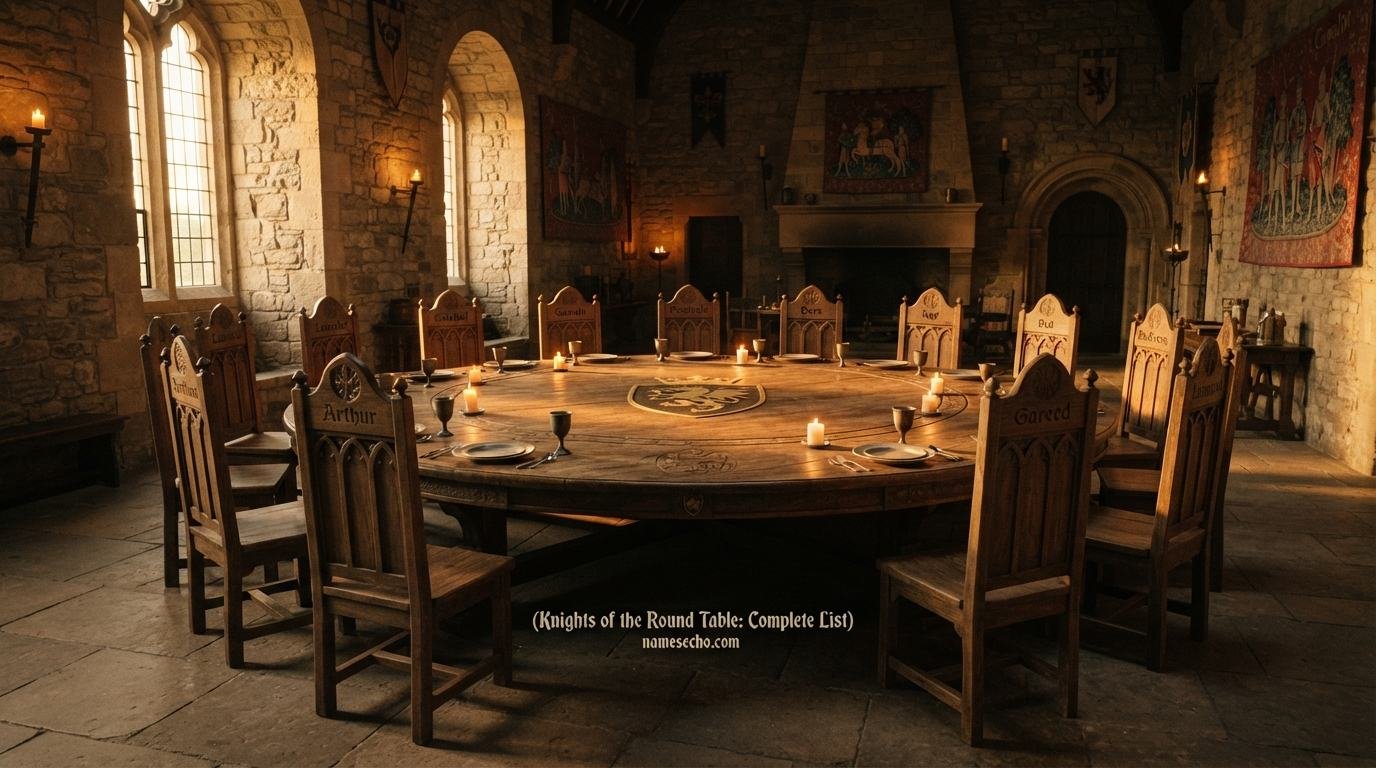
A truly complete list of Arthurian knight names does not exist, because the number of knights shifts from text to text. Some sources give a small circle of twelve. Malory describes a table that seated 150. What follows is the widest commonly cited roster, grouped by role in the stories.
The great knight names: Lancelot, Gawain, Percival, Galahad, Bors, Kay, Bedivere, Tristan, Gareth, Mordred.
The Orkney brothers and kin: Gaheris, Agravain, Gingalain, Lamorak.
Grail and quest knights: Palamedes, Ector de Maris, Lionel, Pelleas, Elyan, Tor, Safir, Segwarides, Urre.
Courtiers, companions and champions: Dagonet, Pellinore, Dinadan, Sagramore, Griflet, Bagdemagus, Balin, Balan, Ironside, Marhaus, Yvain, Erec, Geraint, Lucan, Bleoberis, Brunor, Galehaut, Lanval, Accolon, Caradoc, Cador, Colgrevance, Dodinel, Helyan, Hector, Mador, Meliant, Persant, Pinel, Sanam, Alymere.
Gawain is a good case study in how these names behave. In Welsh tradition he is Gwalchmai, and the English spelling Gawain only settled after centuries of retelling. If you want Arthurian knight names without borrowing an existing hero, take a lesser-known knight from the list above. Dinadan, Dagonet and Brunor are all underused. Because spelling varies between sources, pick one version of your Arthurian knight names and use it consistently.
🌑 Dark Knight Names
A dark knight does not have to be a villain. Some are exiles, some are oath-breakers seeking penance, and some are simply heroes who work at night. These dark knight names are invented, but they borrow sounds from Old English and Norse so they feel earned.
Dark knight names: Draven, Malachar, Voss, Ravengard, Nyxar, Corvane, Zerath, Grimwald, Malvek, Thane Ashgrove, Kaelor, Morrigar, Blackthorn, Vexian, Dreadmoor, Sable Aldric, Umbral Cade, Wraithmere, Dusk Harrow, Nightbane, Ebon Roderic, Crowhelm, Ashen Gareth, Gravemoor, Thorne Valken, Shadowmere, Cinder Osric, Duskwarden, Ravenscar, Hollowmere.
Dark knight names work best when paired with a motive, so decide what the character lost before you name him.
Also Read This: 200+ Nicknames for Jackson: Funny, Cute & Cool Picks
💀 Death Knight Names
Death knight names come from fantasy more than from history. They are fallen champions bound to something unnatural, and their names should sound as if they have lost a little warmth. A useful trick is to take a noble name and add a cold epithet, so a once-proud title still echoes under the damage.
Death knight names: Morthain, Graveborn Alaric, Ossian, Hollow Vael, Drakos Vael, Mortis, Lord Cinderhelm, Thrall Gareth, Bonewarden, Revenant Aldous, Gravelord Osric, Pale Roland, Crypt Warden Hugh, Ashen Tancred, Tomb Captain Rolf, Deathbringer Cade, Sir Malrik the Risen, Soulbound Edric, The Cold Marshal, Grimhelm, Rotbane, Dread Lothar, Ebonvault, Marrowguard, Netherlance, Wightbrand, The Unquiet Baron, Gravewalker Piers, Dirgeblade, Last Vigil.
To keep death knight names from sounding like parody, use only one grim word per name.
⬛ Black Knight Names
The black knight is one of the oldest archetypes in chivalric stories. Arthurian romances are full of color-coded knights, red, green, white and black, who often turn out to be someone else in disguise. Walter Scott’s Ivanhoe features a Black Knight who hides a royal identity, and the Black Prince is the best-known historical example of the color in a name. Monty Python made the most famous comic version.
When choosing black knight names, remember that the color suggests secrecy more than evil. Think of a name as a mask the knight wears.
Black knight names: Sir Blackwood, Corvin, Ebonmere, Raven Aldwin, Sable Roland, Night Marshal, Obsidian Hugh, Jet Gareth, Black Osric, Coalhelm, The Midnight Lance, Dark Lord Rainier, Onyx Tancred, Pitch Warden, Sir Umber, Darkwater Piers, Blackthorne, Ironraven, Soot Baldric, Dusk Champion, Shade of Ravenscar, Cinder Prince, The Nameless Knight, The Silent Visor, Sir Charcoal.
Black knight names are best kept to a single color word, with the rest of the name doing the quiet work.
✝️ Holy Knight Names
Faith and warfare were closely tied in the Middle Ages, and the military orders turned that tie into an institution. Holy knight names often draw on saints and virtues. Saint George became a patron of England and of knights, and Saint Michael was invoked as a heavenly warrior. Saint Martin of Tours began as a soldier. Those names work well for characters who believe in what they fight for.
Holy knight names: Aurelian, Benedict, Cassian, Clement, Gabriel, George, Gregory, Jerome, Justin, Lazarus, Leo, Martin, Michael, Nicholas, Raphael, Sebastian, Stephen, Theodoric, Uriel, Valentine, Victor, Vitalis, Zachary, Agnes, Catherine, Cecilia, Clare, Lucia, Margaret, Perpetua.
Holy knight names gain depth when the saint’s story echoes the character’s own.
Paladin & Holy Knight Names for DnD
The word paladin goes back to the legendary peers of Charlemagne, such as Roland and Oliver. Dungeons & Dragons turned it into a class, a holy warrior bound by an oath. In the fifth edition rules, the official oaths include Devotion, the Ancients, Vengeance, Glory, Conquest, Redemption and the Watchers, and each one suggests a slightly different naming style.
A Devotion paladin might carry a plain virtuous name like Seraphine Brightvale. An Ancients paladin suits something from nature, like Elowen Greenwarden. A Vengeance paladin does well with something blunt and unforgiving. Whatever the oath, paladin knight names read best when the first name is simple and the surname carries the theme.
Paladin and holy knight names: Seraphine Brightvale, Elowen Greenwarden, Aldous Truehand, Isolde Dawnmantle, Gareth Oathkeep, Valeria Sunward, Benedict Ironvow, Cassian Lightbringer, Thea Silverbrand, Roland Hallowmere, Mirabel Starshield, Osric Dawnbringer, Beatrice Goldenhelm, Lucan Truthward,
Clara Radiantblade, Tobias Holyshield, Evander Brightlance, Genevieve Stillwater, Hugo Vowsworn, Rosalind Daybreak, Percival Sunmantle, Adelaide Oathbound, Anselm Candleward, Philippa Dawnspear, Ambrose Gracewell, Cordelia Lightfall, Leofric Hearthward, Maud Sunhallow, Edric Faithsmith, Sabine Vigilant.
Majestic Order Designations and Radiant Champion Identity Blueprints
A knight is often defined by the order he serves. Here are order names that sit comfortably beside your knight names, along with a quick blueprint for building your own: choose a virtue or a light-related word, attach it to an object or place, and put Order of the in front.
Order names: Order of the Radiant Dawn, Order of the Silver Chalice, Order of the Golden Lance, Order of the White Rose, Order of the Eternal Flame, Order of the Steadfast Shield, Order of the Morning Star, Order of the Sacred Oak, Order of the Crimson Vow, Order of the Pale Banner, Order of the Lion’s Crown, Order of the Rising Sun, Order of the Azure Gauntlet, Order of the Gilded Sword,
Order of the Sentinel Flame, Order of the Evening Bell, Order of the Verdant Lance, Order of the Argent Star, Order of the Hallowed Gate, Order of the Seven Virtues, Order of the Tempered Blade, Order of the Winter Watch, Order of the Humble Hand, Order of the Ivory Tower, Order of the Burning Shield.
💀 Evil Knight Names
An evil knight reads best when the name sounds almost honorable. Villains who announce themselves with a skull and a growl are easy to dismiss. A smooth name that gradually seems wrong, like a polished helm with a crack in it, tends to unsettle readers more. These evil knight names run from subtle to blunt.
Evil knight names: Malrik, Vorgath, Sir Mordain, Lord Hexen, Baron Grimmel, Cruel Roderic, Skarn, Valdric, Sir Hallow the False, Dread Marshal Osric, Lord Carrion, Blightbane, Sir Moloch, Vaelor, Duke Thessaly, Warlord Krag, Sir Corbin the Forsworn, Drazek, Baron Ravenholt, Count Vorlund, The Hollow Crown, Sir Garrick Vane, Lord Ashmoor, Betrayer of Dawn, The Usurper Lance, Sir Falken the Cruel, Malgrave, Lord Sorrow, Hexblade Tancred, The Iron Tyrant.
A final tip on evil knight names: give the villain one believable virtue, and the name will feel less like a label.
🌟 Legendary Knight Names
Legendary knight names come from medieval romances, chansons and epics, the stories that were told long before they were written down. Many of these figures are semi-historical or entirely invented, but their names have lasted for centuries. Roland and Oliver come from The Song of Roland. Ogier the Dane, Huon of Bordeaux and Fierabras belong to the Charlemagne cycle. Orlando, Rinaldo, Astolfo and Bradamante come from the Italian epics. Bevis of Hampton and Guy of Warwick were English romance heroes. Any of them can lend an old-world sound to new knight names.
Legendary knight names: Roland, Oliver, Ogier the Dane, Huon of Bordeaux, Fierabras, Orlando, Rinaldo, Astolfo, Bradamante, Ruggiero, Bevis of Hampton, Guy of Warwick, Amadis of Gaul, Palmerin of England, Tirant lo Blanc, Lohengrin, Parzival, Sir Gowther, Sir Orfeo, Sir Launfal, Sir Degaré, Sir Isumbras, Sir Eglamour, Sir Lanval, Sir Tristrem, Sir Perceval of Galles, Siegfried, El Cid, Bayard, Tannhäuser.
🐉 Fantasy Knight Names
Fantasy knight names let you borrow the feel of the medieval without being tied to it. The easiest approach is to take a real root and bend it. Change one vowel, add a double consonant, combine two old elements or attach a nature word. The results below follow those methods.
Fantasy knight names: Aldrenar, Brannoch Stoneward, Caelith, Dunmarrow, Eryndor, Fenwick Hale, Garrowick, Hathor Brandt, Ilmarec, Jorvane, Kestrel Voss, Lothgar, Maelor, Nimbrel, Orwyn Thane, Perrin Ashdown, Quillon, Rhosgar, Sarnoth, Taranis Wren, Ulvaric, Vandrel, Wystan Holt, Xanthor, Yvandor, Zephyrin, Aveth, Bronnic, Corwin Hale, Drustal, Eldermar, Faolan, Gwydion Marsh, Halvarec, Ithrandir Cole, Jessamin Rook, Kaelan Thorne, Lysander Pike, Merrowick, Norvane.
These fantasy knight names can be shortened into nicknames, which readers often prefer after the first chapter.
👑 Royal Knight Names
Royal knights serve the crown directly, and their names tend to sound polished. Real honors help here. The Order of the Garter dates to 1348, the Order of the Thistle to 1687 and the Order of the Bath to 1725, and each has produced its own style of title. In fiction, royal knight names often include a rank, such as Lord Commander or Knight-Marshal, followed by a house name.
Royal knight names: Lord Commander Aldous, Captain Edric Valmont, Sir Reginald Crownguard, Knight-Marshal Hugh, Sir Percival Kingsley, Lady Isolde Royalwatch, Sir Lucan of the Crown, High Constable Osric, Sir Edmund Kingsmead, Dame Beatrice Regent, Sir Cassian Thronehall, Lord Warden Gilbert, Sir Alaric of the Court, Captain Philippa Crownward, Sir Humphrey Highcourt, Sir Roland of the Realm, Sir Tancred Sceptre, Lady Matilda Royal Lance, Sir Leopold the Loyal, Sir Gareth Crownsworn, Sir William Regalis, Knight of the Garter, Knight of the Thistle, Sir Conrad Kingsward, Sir Baldwin Princeguard, Sir Aubrey Thronewell, Dame Eleanor Highsword, Sir Rainier Palacegate, Sir Oswald Crownbrand, Sir Theron Royalmane.
Royal knight names should read well on a banner, so test them at heading size.
🛡️ Knight Last Names & Surnames
A first name opens the door but a surname sets the house, which is why knight last names matter as much as the first ones. Good knight names work as a pair. Real surnames of the knightly class mostly fall into two camps. Some come from a place, and some come from a description. A third group, darker and more fanciful, belongs mostly to modern fantasy.
Estate & Location-Based Surnames
Location-based knight last names usually use de in French and Norman examples and von in German ones. The first twelve below belonged to real English noble families. The rest are invented in the same style. Place-based knight names are the easiest to invent: pick a landscape word and a building word and join them.
Estate and location surnames: de Montfort, de Clare, de Lacy, de Vere, de Bohun, de Warenne, de Mowbray, de Beaumont, de Courcy, de Ferrers, de Burgh, de Valence, de Braose, de Quincy, Ashford, Blackmere, Hawksworth, Stonebridge, Thornfield, Ravenscroft, Wyndham, Oakhaven, Greyfell, Ironwood, Westmarch, Dunmere, Ellsworth, Fairholt, Harrowgate, Kingsmead, Lockhart, Marlowe, Northcote, Redcliffe, Silverbrook, von Falkenburg, von Hohenrath, von Eschenbach, von Lindenau, von Tannberg.
Descriptive & Epithet-Based Surnames
Descriptive knight last names show what a person looked like or did. Fairfax meant fair hair. Armstrong is exactly what it sounds like. Descriptive knight names are the quickest to invent. Some of these entries, such as Longshanks, Strongbow and Lackland, were nicknames of actual medieval nobles.
Descriptive and epithet surnames: Armstrong, Fairfax, Whitlock, Redmane, Longshanks, Strongbow, Lackland, Ironside, Barefoot, Bigod, Stout, Hardcastle, Truesdale, Swiftsure, Brightblade, Kingsley, Goodrich, Grimshaw, Hawkins, Longsword, Swiftblade, Truesword, Hardy, Lightfoot, Goodfellow, Strongarm, Blackbeard, Greaves, Stalwart, Brandish, Shieldwright, Spearman, Hartwell, Ironhand, Fleetfoot, Warhorse, Oathman, Stoutheart, Sharpe, Swordsmith.
Dreaded Shadow-Bound Aliases and Dark Fantasy Paladin Tags
For characters who live between light and darkness, a tag can say more than a surname. These dark knight names work as aliases, handles or titles for dark paladins, fallen knights and anti-heroes.
Shadow-bound aliases: The Shadow Oath, Umbral Paladin, Veil Warden, Nightsworn, The Pale Penitent, Duskbound, Ashen Vow, Gravewarden, The Hollow Saint, Eclipse Knight, Dread Templar, Gloomguard, The Mourning Blade, Cinder Saint, Twilight Sentinel, Oathbreaker, Dawn’s Exile, Void Paladin, Sorrowsworn, The Unlit Flame, Ravenwarden, Moonless Vow, The Silent Penitent, Shade Lancer, Fallen Aegis.
😄 Funny Knight Names
Humor is its own tradition in knight names and knightly stories alike. Cervantes’s Don Quixote is a joke built on chivalric ideals, and Monty Python’s Sir Robin and Sir Bedevere are comfortable parodies. The simplest funny knight names rely on puns, but the best ones also hint at a character flaw. Keep them clean and keep the joke short.
Funny knight names: Sir Loin of Beef, Sir Cumference, Sir Render, Sir Prize, Sir Plus, Sir Vival, Sir Real, Sir Rinse-a-Lot, Sir Clanks-a-Lot, Sir Reginald the Slightly Rusty, Sir Squires-a-Lot, Sir Naps-a-Lot, Sir Limps-a-Bit, Sir Tripsalot, Sir Lost-a-Lot, Sir Dents-a-Lot, Sir Faints-a-Lot, Sir Pun-a-Lot, Sir Mumbles, Sir Sneezes-a-Lot, Sir Clumsy of Kettlebridge, Sir Hungry the Brave-ish, Sir Gallops-Backwards, Sir Forgets-His-Sword, Sir Reluctant, Sir Bigger-on-the-Inside, Sir Muffin of the Moat, Sir Wobbles, Sir Ponders-a-Lot, Sir Dither.
Funny knight names land best when only one character in the story carries one.
📛 Knight Nicknames & Epithets
Epithets are the oldest form of branding. Richard I was the Lionheart, called Coeur de Lion in French. Edward I was the Hammer of the Scots. Pierre Terrail, known as the Chevalier de Bayard, was called the knight without fear and beyond reproach. Henry Percy was Hotspur. Nickname-style knight names worked because they were short, vivid and a bit unfair. Those traits are worth copying.
Nicknames and epithets: the Lionheart, the Bold, the Fearless, the Pious, the Marshal, the Hammer, the Conqueror, the Good Knight, the Kingmaker, Hotspur, the Black Prince, Longshanks, Strongbow, Lackland, Coeur de Lion, the Stern, the Gallant, the Valiant, the Steadfast, the Grim, the Quick, the Tall, the Red, the Grey, the Younger, the Unyielding, the Dauntless, the Honest, the Wary, the Just.
Add one of these epithets to any entry above and ordinary knight names start to feel like legends.
🎮 Knight Names from Literature, Games & Film
Stories give us some of the most recognisable knight names. Knight names from books, games and movies are fine as inspiration, but they belong to their creators. If you plan to publish or sell your own project, treat them as a starting point and adapt them rather than copying a character outright.
Ivanhoe, Don Quixote, Sir Gawain and the Green Knight, the Knights of Dol Amroth in Tolkien’s world, the Knights of Solamnia in Dragonlance, Brienne of Tarth, Ser Barristan Selmy and Ser Duncan the Tall in George R. R. Martin’s work, and the unforgettable Sir Didymus in Labyrinth all show how many tones the knight can carry.
Hollow Knight Character Names
Hollow Knight, the 2017 game from Team Cherry, uses a small number of beautifully short names, many of which feel like folk titles. Its characters are mostly insects, but the naming patterns work for knights too. Short, odd and softly spoken is a recipe worth borrowing for your own knight names.
Hollow Knight character names: Hornet, Quirrel, Zote the Mighty, Cornifer, Elderbug, Sly, Iselda, Tiso, Cloth, Lemm, Myla, Willoh, Bretta, Nailsmith, Sheo, Oro, Mato, Grimm, Brumm, Divine, Bardoon, Hunter, Tuk, Gorb, Marissa, Nosk, Galien, Markoth, Xero, Marmu, No Eyes, Millibelle, Salubra, Herrah, Monomon, Lurien, Pale King, White Lady.
Video Game Knight Names
Games love knights, partly because the archetype is easy to read. These video game knight names come from well-known series, and several also work as inspiration for your own characters.
Video game knight names: Solaire of Astora, Artorias, Ornstein, Siegmeyer of Catarina, Oscar of Astora, Lautrec, Sir Alonne, Cecil Harvey, Ramza Beoulve, Agrias Oaks, Sir Arthur, Sir Daniel Fortesque, Henry of Skalitz, Godrick, Radahn, Margit, Malenia, Uther the Lightbringer, Tirion Fordring, Bolvar Fordragon, Arthas Menethil, Alistair, Cullen Rutherford, Geralt, Sturm Brightblade, Link, Fire Emblem’s Seth, Sir Lancelot, Gilbert, Percival.
Use these as models for your own knight names, not as direct copies.
Epic Quest Character Titles and Virtual Realm Knightly Handles
If you need a username, guild tag or in-game handle built from knight names, start with a strong noun and add a number or a place. Short handles are easier to read in chat, and the formula of virtue plus weapon is hard to beat.
Quest titles and handles: QuestKnightRoland, IronLancer, SilverBannerSir, TheLastPaladin, VowKeeper, DawnShield, Knight_of_Embers, GalahadRising, SirLoyal, OathHammer, HelmAndHeart, LanceOfTheNorth, Gallantry, PaladinPrime, RampartRiley, ShieldOfGrey, BannerOfDusk, HalberdHeir, ValorMarch, KnightWatch, CrownedLancer, SteelVow, TheWanderingKnight, AuroraBlade, EmberGuard.
🛠️ How to Create Your Own Knight Name
Custom knight names often beat borrowed ones. Here is a method that works whether you are writing a novel, building a campaign or designing a game character.
- Settle the setting. Decide whether your knight lives in a Norman court, a German duchy, a Celtic border kingdom or a fully invented world. This choice drives every other decision.
- Choose a root. Take a real name or name element from the lists above. Hard, short roots like Rolf and Gar are easy to work with.
- Bend it. Swap a vowel, add a suffix or merge two roots. Roderic and Garrick can become Rodgar. Aldwin and Osric can become Aldric.
- Add the second label. A place, a trait, a deed or a nickname. “Sir Rodgar of Greyfell” works because it implies a history. “Sir Rodgar the Lame” works because it implies a wound. Second labels are what turn ordinary knight names into memorable ones.
- Say it aloud. If the name trips you up, simplify it. If it sounds like an existing character, shift a letter.
- Check the title. Use Sir with the first name, Dame for modern female honors, or the rank and order you invented.
- Test it in a sentence. “Sir Rodgar of Greyfell drew his sword” should read smoothly. If it feels clumsy, so will the rest of your page.
Treat all of this as a starting point. Many of the most memorable knight names break the rules deliberately, and that is fine if you know which rule you are breaking.
❓ Frequently Asked Questions
What is the difference between a knight and a paladin?
A knight is a historical or feudal rank, while a paladin in fantasy is a holy warrior bound by an oath. The term originally referred to Charlemagne’s legendary peers.
Can women be knights?
Formal medieval knighthood was almost always male, though noblewomen led troops and defended castles. In modern Britain, women receive the equivalent honor as Dames, and fantasy settings are free to use female knights.
Did knights have last names?
Many did not, at least at first. Hereditary surnames spread slowly after 1066, and knights were often known by a place, a father or a nickname.
How do I use “Sir” correctly?
Pair it with a given name, such as Sir William or Sir William Marshal, never with a surname alone. Women with the modern equivalent use Dame in the same way.
Can I use knight names from games or films in my own project?
Real historical and legendary names are free to use. Names from specific games or films are best treated as inspiration, particularly for anything commercial.
Also Read This; 200+ Contact Names for Girlfriend: Cute, Romantic & Funny
🏰 Conclusion
Good knight names are rarely found by luck. They are built, usually from a plain root, a little history and one detail that sticks in the reader’s mind. William Marshal, Strongbow and Hotspur all prove the point. The most enduring labels were simple, specific and slightly unfair to the person who wore them.
Use the lists above as a workshop, not a menu. Take a name, change it, add a place or an epithet, and read it aloud until it stops feeling borrowed. If you want to keep experimenting, the namesecho.com generator will keep producing fresh knight names whenever the page feels stuck.

I am researcher and content writer with over four years of experience exploring the meanings, origins, and cultural significance of names from around the world. I specialize in creating well-researched, accurate, and easy-to-understand content that helps readers discover the perfect names for babies, businesses, pets, characters, and more. Every article is carefully crafted to provide trustworthy information and practical guidance for visitors.
4 thoughts on “700+ Best Knight Names: Medieval, Fantasy & Epic Name Ideas”